1. In Search of Saltiness

Way out in the heart of the American West, Salt Lake City, Utah, is known as the center of the Church of Jesus Christ of Latter-day Saints, commonly called the Mormon Church. Invited to a national conference for editors there this spring, I realize that I have an unexpected chance to learn more about the Mormons. The conference hotel is near Temple Square, the hub of the church’s places of worship.

While flying east from California to Salt Lake City, I sort through my scattered knowledge. Since childhood, I’ve had nice Mormon friends, but I always hesitated to ask about their faith. Details gleaned from random sources had intrigued me with no real impact. I loved John D. Fitzgerald’s then-popular series of “Great Brain” children’s books, which followed the adventures of boys in a mixed Catholic-Mormon family in late 19th-century Utah, learning lessons about tolerance while living as “gentiles” among Mormons. Yet these books appealed to me not as sociology, but because of their characters’ mischievousness and their escapades’ poignancy.

In Sunday school, a visiting speaker once told my class about her experience growing up adjacent to the faith in Utah — a setting she’d felt glad to escape. Yet sad to say, I also felt increasing discomfort in my own church’s parochial program, fine as it may have been.

Later, in my senior year, Mormonism was part of my high school’s world religions curriculum. The two young Mormon men who visited to explain their faith found that doctrines like their church’s ban on alcohol, tea and coffee faced a tough audience among the teenage students. Separately, a friend found the Book of Mormon in a thrift store and tried to read it for fun, struggling with its unusual style and content. At that time, I was more interested in the beatniks’ thoughts on religion.

My family, based in the western U.S., occasionally vacationed in Utah, and I visited my brother a couple of times when he temporarily moved there for grad school in a smaller town than Salt Lake City. I had no meaningful interactions with Mormons there, though.

Since then, I’ve had little reason to visit Utah or think about its founding faith. Still, approaching the state again to discuss editorial craft, I feel an urge to clarify my vague impressions.

Even those unfamiliar with the Mormon church may have heard about its history and tenets, which include strict moral codes and mandatory two-year missions that increase the likelihood of encountering church members worldwide. Founded in the early nineteenth century by Joseph Smith, the church is based on his testimony of discovering the Book of Mormon inscribed on ancient gold plates, which he claimed to have translated before returning them to an angel.

Smith maintained that after the death of the apostles, the Christian church had lost its revelatory reference points regarding Christ’s teachings, and that the first restoration of direct apostolic authority had occurred transcendently through him.

The Mormon church’s development is linked to its members’ westward migration from the Eastern states, culminating in their movement to future Utah along the Mormon Trail. The Mormons saw these western expanses as their Zion — a promised land. Their success in cultivating this harsh terrain contributed to their reputation for industriousness. Over time, they became a significant force in global spirituality, economics, and philanthropy.

The Mormon faith has inspired both admiration and ambivalence, yet all religions provoke their share of resistance. I try to move beyond my previous superficial approach to this topic, remaining as neutral as seems right.

“Joseph Smith Receives the Plates” (from the Angel Moroni). Sculpture in Temple Square, Salt Lake City


As my flight crosses the Sierra Nevada mountains and the Great Basin Desert, I’m reminded of the forbidding landscapes the Mormons traversed to reach their future homeland. Indigenous tribes may have roamed these regions, but the vast continent is a setting able to pose countless harsh ordeals. This wild West remains quite wild today.

Rare dirt roads stretch across barren plains and trace ridgelines of solitary mountain ranges, then fade into nothingness. Why do these roads exist? How much are they still traveled? Desert monastics’ discipline would come in handy out here, yet the land’s harshness would challenge even their resilience.

To cross such territories by wagon, cart and foot required extraordinary determination. Settlement by the Great Salt Lake, rather than continuing to California or Oregon like other pioneers and seekers of fortune, reflected a no less remarkable intuition.

Roads in the Great Basin Desert, Western US

Roads in the Great Basin Desert, Western US


The southern part of the lake comes into sight by the warm glow of sunset, which intensifies the water’s phantasmagoria — emerald green with scarlet plumes, the colors of algae that thrive in high salinity. The lake, a remnant of a much larger prehistoric body of water, continues to shrink and risks disappearance, pressured by seasonal heat and neighboring population growth. Yet its eerie beauty remains breathtaking. In the lake’s northern part, separated by a railroad causeway, a different kind of algae tints the waters red. Punctuating the shoreline, islands of rugged crags extend into the lake, hinting at submerged geology.

At a respectful distance from the eastern shore lies Salt Lake City. The metropolis sits in a valley framed by panoramic mountains. The Mormon settlers discerned heavenly providence in this landscape, which gave them glorious beauty and sources of water, timber, and soon mineral wealth.

It’s easy to see how these spaces accommodated the Biblical archetype of the Israelite exodus, which formed the governing metaphor for so much of the colonization of the New World. America’s deep wilderness mirrors that of the Sinai Peninsula, and the pioneers’ trail evoked the goal of the ancient land of Canaan, open for claiming and cultivation by settlers fleeing persecution and following dreams. The Great Salt Lake itself is an obvious twin of Israel’s Dead Sea, with a primal otherworldliness that complements the mountains’ majesty.
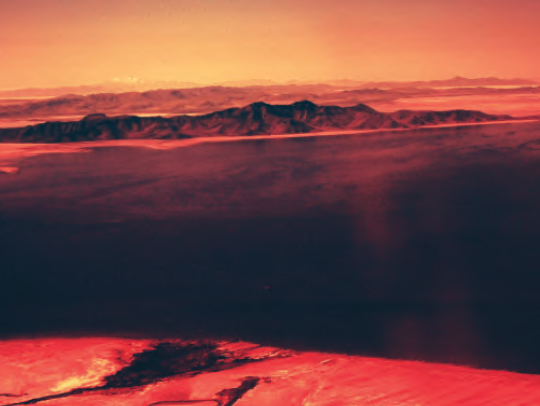
Great Salt Lake

Great Salt Lake


The skyscrapers of a downtown area grow ever larger in the distance. The low, flat roofs of warehouses and data centers testify to the local culture’s adaptability.

Then we touch down, nestled among the mountains. On the tiled floor of the airport terminal, a large embedded map shows routes radiating from Salt Lake City to spots around the globe. By the converging logic of prophecy and modern transportation, this once-isolated valley — though still surrounded by vast expanses of wilderness — occupies a central position on the planet, like a Jerusalem or Mecca for today’s Western Hemisphere. We’re at an abstract point in a homogenized world, but also in a place with its own distinct ecology and culture.

In a niche by the windows overlooking the airfield stands the skeleton of a massive predatory dinosaur. On the ceiling of a long tunnel between terminals, blue lighting imbues undulating aluminum with enough of the atmosphere of a mountain riverbed to make it feel more tolerable to pass through, serenaded by water-themed songs like “Take Me to the River.” Beyond, white benches rise in layered formations, higher than human height, evoking the state’s iconic canyons. Then the airport’s secure zone ends, giving way to groups of waiting people with “Welcome, Elder” signs.

River Tunnel, Salt Lake City Airport

River Tunnel, Salt Lake City Airport


At the first stop on the commuter train ride from the airport to downtown, a grizzled, stocky man boards and starts playing harmonica. A fellow passenger asks him if he’s been playing long. “Since I was ten years old,” the man replies in a raspy, throaty voice. “I taught myself, but I’ve had lessons. The harmonica player in Blues Traveler has heard me play and says I’m one of the best harmonica players in the world.” He disembarks at the Utah State University stop.

“We got lucky with that concert,” I remark. “Anything can happen on the Green Line,” says the passenger, a goateed, hippyish young man with a frame pack. “I ride it to work and back every day, and I’ve seen everything.”

Reminding myself to temper my preconceptions about Utah, I notice we’re sharing the train with a clean-shaven, friendly-looking man in a suit and tie, sitting one seat past the hippy. “How many stops to Temple Square?” he asks.

“Just a couple,” says the hippy, who makes sure we disembark correctly and wishes us well.

The smartly dressed man and I leave the train and pause together at the nearest intersection. “I need to get my bearings,” he says, hesitant but cheerful.

“Me too,” I respond. “Is this your first time here?”

“Oh, no, I’ve been here many times. It’s just been a while. I came up from Texas for a general conference. I’m an Area Seventy now, actually.”

I don’t ask him to explain what that means, but I guess it has evangelical antecedents. “I’m here for a conference, too,” I say. “A conference of editors.”

The man responds to this enthusiastically. We realize our hotels are in the same direction, down South West Temple Street, so we walk together. When I mention that I’d like to use my time between conference sessions to learn about his church, he seems pleased. “You might not be able to get into my conference, though,” he says, with good-natured chagrin. “There are tickets, and all of them are sold out. Thousands of people come here twice a year from all over the world.”

He reckons the Salt Lake Temple, too, will be closed for renovation for at least another year and a half. Still, he assures me Temple Square offers much else to see. By Saturday, too, the escalating general conference will find the area packed with crowds.

Reaching his hotel before mine, we shake hands in farewell, exchanging names and wishing each other wonderful conferences. “I just know you’re going to do well in your career,” he says in a warm Texan drawl, his face beaming goodwill.

Our nocturnal exchange has passed generically, yet feels charged with some special quality, bigger than whatever beliefs we might hold.

I later learn that “Area Seventies” are part of the Mormon hierarchy, related to the seventy disciples mentioned in the Gospel of Luke as sent by Christ. “Quorums of the Seventy” exist in every part of the world. Viewing their structures as directly inherited from the early apostolic church, the Mormons are highly organized, with an administrative charism blending church leaders with laity.

I drop off my bags at my hotel, then make a quick grocery run to Harmon’s, a local institution, just before closing time. A new moon rises over Salt Lake City. The “Why KiKi” bar advertises “Drag shows every Saturday.” Girls in short skirts and tall leather boots walk by, and fresh vomit adds risk to the tidy sidewalk outside Harmon’s — more reminders that not all the region’s inhabitants stick to traditional strictures.

Back in my ninth-floor room, I open the curtains and see the still snow-capped mountains, a looming US Bank branch, and the illuminated Utah state capitol’s classical dome peeking between the headquarters of Zions Bank — founded by Mormons and still closely connected with their church — and another office tower. The tower obscures my view of the main temple, if not of the cranes parked beside it. Clouds of steam rise from heating ducts into the cold night air. Resources circulate and combust.

This country’s current president has designated this date, one slot beyond April Fool’s Day, as “Liberation Day,” a day when the United States will reorder its relationship with the world. The immediate topic is trade, but the implied context seems broader. The world is said to be turning away from America, but Salt Lake City is still refurbishing its temple — staying on its own American path, come what may. In the maze of the trails of humanity, what might real liberation be?
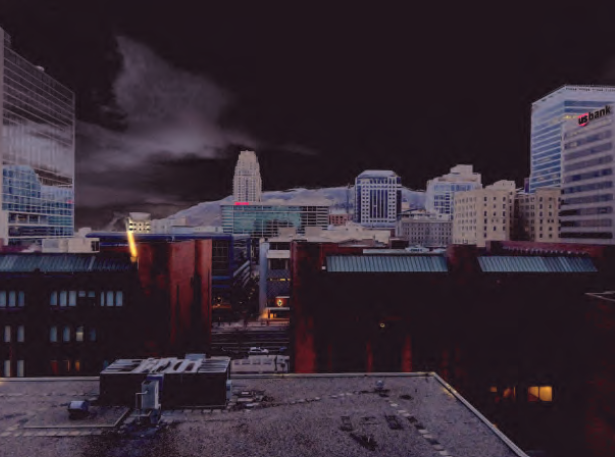
Downtown Salt Lake City

Downtown Salt Lake City


  1. A Hive of Dreams and Visions

The next day, during a long break after a conference session on fact-checking, I walk up to Temple Square, a landscaped area surrounding the neo-Gothic main temple and dotted with other structures important for the faith. On the nearest corner stands the plainer neo-Gothic of the Salt Lake Assembly Hall. Beyond that extends the oval-shaped pavilion of the old Mormon Tabernacle. The square around the Tabernacle teems with monumental cast-iron sculptures from the last century and the current one. Each sculpture is rendered in a painstakingly traditional style.

Salt Lake City Assembly Hall

Salt Lake City Assembly Hall

“Restoration of the Melchizedek Priesthood.” Sculpture in Temple Square, Salt Lake City


The scale of the Mormon historical worldview is immediately evident in “Restoration of the Melchizedek Priesthood,” which depicts the apostles Peter, James and John placing their hands on the head of Joseph Smith, accompanied by Oliver Cowdery, a witness to his prophetic acts. Nearby, in “Restoration of the Aaronic Priesthood,” John the Baptist gives Smith and Cowdery the power to baptize. Opposite, Smith discovers the golden plates of the Book of Mormon with the aid of the Angel Moroni. On the tabernacle’s far side, a sculpture illustrates the so-called First Vision, when the first two persons of the Holy Trinity reportedly appeared to fourteen-year-old Joseph in the woods of his home state of New York. Beyond this stands a more conventional Gospel tableau, “Come, Follow Me,” where Jesus summons two fishermen. Each sculpture depicts its subject with equal realism and heft — Joseph Smith’s visions rendered with the same physical certainty as Christ calling his disciples.

I find myself caught between admiring the sculptors’ skill and commitment to classical forms, and uncertainty about interpretation. Are these works monuments, art, devotional aids, or something else entirely? The bronze is beautiful, yet the physical rendering of Smith’s revelations alongside a traditional Gospel scene implies equivalence. The sculptures speak to the universal human longing for connection with the divine, but also represent claims that fundamentally challenge centuries of Christian belief — which others challenge, of course, for other reasons. The resulting sculptural ensemble mixes spiritual archetype with Mormonism’s foundational claims.

Beyond a fence displaying a large photograph of the original temple dedication ceremony, the temple itself stands under renovation. The Angel Moroni on its tallest spire overlooks a lattice of scaffolding, attended by cranes hoisting pallets. Mormons tithe a tenth of their income to their church, giving it a solid financial foundation. Taken as a plain fact, such a sacrifice may seem unquestionably laudable.

The majestic temple is set against the even taller “Church Office Building,” a typical postmodern office tower of the sort that came to dominate the second half of the 20th century. The building’s observation deck is said to offer excellent views of the mountains, the Great Salt Lake, and the temple from above — though perhaps spiritual perspective depends on factors beyond elevation. The stylistic contrast between the temple and the office tower might strike some as jarring, yet many Latter-day Saints may welcome such juxtapositions as expressions of their faith’s vitality. Similar currents exist in mainstream Christianity and other religions.

Salt Lake Temple under construction (left) and current renovation (right)

Salt Lake Temple under construction (left) and current renovation (right)


“Come, Follow Me” sculpture near the Mormon Tabernacle


Inside the Mormon Tabernacle

Inside the Mormon Tabernacle


The Mormon Tabernacle has the sumptuousness of a grand Masonic lodge. Even beyond the boundaries of the faith, an eponymous choir has brought the venue decades of renown. Signs declare the building open for self-guided tours, while at the interior’s focal point, a young woman in an old-fashioned dress faces a small excursion group, whose members watch her from the hall’s midpoint. Framed by a semi-circle of plush red choir seats and overlooked by a huge pipe organ, she drops three grains, one after another, onto a lacquered wooden table. Each grain’s fall is distinctly audible, illustrating the hall’s exceptional acoustics.

Log cabin from the time of Salt Lake City's settlement

Log cabin from the time of Salt Lake City’s settlement


Across the street stands a Mormon genealogical center, offering help in identifying ancestors in need of prayers. Beside it crouches a humble log cabin preserved since the days of the Mormon pioneers. Next to the cabin is a church history museum, where mingled languages indicate a significant number of international visitors.

The museum depicts stages in the emergence of the faith, from the young Joseph Smith receiving his first vision in the woods to the adult Smith finding the Book of Mormon’s golden plates. A replica of that legendary vanished treasure sits in a glass case. Men in suits and women in modest dresses await questions and tend the displays, eager to engage with visitors, yet maintaining a polite restraint.

One woman, leading a group of children, directs their attention to a framed photograph. “Those are seer stones,” she says. A little girl exclaims, “I know about them!” The smooth, egg-shaped stones, their originals closely guarded elsewhere, were said by Smith to have been among his aids, along with angelic guidance, in translating from the golden plates’ script into an English reminiscent of the King James Bible.

Exhibits at the Joseph Smith Museum, Salt Lake City

Exhibits at the Joseph Smith Museum, Salt Lake City


The museum collection also includes domestic items — a corroded spoon, a leather wallet, a rifle, a trunk with its owner’s initials traced in brass studs — from the lives of Mormonism’s founders. Such artifacts are interspersed with objects aimed at promoting the faith, such as an early hymnal, manuscripts of church teaching, and the printing press used for the first five thousand copies of the Book of Mormon.

Each item possesses its own beauty, partly due to antiquity or at least the studious recreation of a vintage source, such as the replica of one of the “sunstones” that served as capitals in pilasters of an early temple. Built before the migration to Utah, that temple was destroyed by arson and natural disaster after persecution forced the Mormons to venture westward.

The death masks of Smith and his brother Hyrum are also on display in the museum, along with the clothes Hyrum was wearing at the time of his death. Two years before the dedication of that temple in Illinois, the brothers were imprisoned at a diminutive town jail, pending trial for treason and inciting a riot. An anti-Mormon mob attacked the jail and murdered them. Today, the historic jail building is owned by the Latter-day Saints as a sacred site.

Copy of a sunstone capital from an early Mormon temple, Joseph Smith Museum, Salt Lake City

Copy of a sunstone capital from an early Mormon temple, Joseph Smith Museum, Salt Lake City


Interpretive materials explain the early church leaders’ ideas about practicing polygamy, described as an option endorsed by Smith’s revelations, despite conflicting with their upbringing and prevailing social conventions. The mainstream Mormon Church has banned polygamy for over a century, but some fundamentalists defy religious and state regulations by staying faithful to this custom, historically integral to Mormonism.

Finally, the exhibition includes items from the Mormons’ settlement of Utah: an ox-drawn cart, a plow, a pair of sheep shears, a violin brought from England. The artifacts vividly illustrate the real lives of their owners, lending tangible weight to the beliefs that came with them.

Cathedral of the Madeleine, Salt Lake City

Cathedral of the Madeleine, Salt Lake City


In neighboring areas of the city, historic non-Mormon churches such as the Catholic Cathedral of the Madeleine and the Orthodox Cathedral of the Holy Trinity bear witness to early waves of migrants from Ireland, Italy, Greece, Russia and Serbia — often arriving to perform dangerous work in the mines and on railroads. More than Mormons have traveled to Utah from far and wide in search of opportunity.

Today, Utah is no longer a majority-Mormon state, although non-Mormons sometimes report feeling pressured in this environment. As orange-vested temple renovation workers pass me on the edge of the square, the ironic tone in their mention of the Assembly Hall leads me to suspect their disaffection.

On a street corner near the hotel, I stop at a box and pick up a free copy of Deseret News. The newspaper appears to be thriving, with a front-page headline proclaiming that “Utah’s growth strategy could guide America’s future.”

This official church newspaper is affiliated with a host of other church media and charitable operations named Deseret, after a Book of Mormon word that Smith said meant “honeybee” in the language of the ancient emigrants to America. The book describes the Israelite travelers bringing honeybees along, affirming their prudence.

Mormon leaders initially proposed the creation of a “State of Deseret” before receiving approval to establish “Utah,” named after a local indigenous tribe. Yet the beehive, symbolizing industry and self-sufficiency, continues to represent Utah. Some crosswalks in Salt Lake City feature a honeycomb pattern, subtly reinforcing this theme. The emblem also often merges with conventional American patriotic iconography.

Beehive symbols on streets in Salt Lake City

Beehive symbology on a Salt Lake City sidewalk


Beehive symbols on streets in Salt Lake City

Beehive symbology on a Salt Lake City street


Nearly a century and a half ago, a Mormon elder’s wife, Susa Young Gates — one of the many daughters of Mormon leader Brigham Young — corresponded with Count Leo Tolstoy. Mentioning Deseret News as a sign of community progress, Gates arranged for the Deseret Book Company to send him copies of the Book of Mormon and a biography of Joseph Smith.

Tolstoy’s diary entry indicates that after his positive impression of the correspondence itself, the great count responded with horror to Mormon literature, prompting more of his characteristic musings on the duplicity of all religions. He went on, though, to express more conditionally tolerant views of Mormonism in a visit with U.S. ambassador Andrew White.

According to White, Tolstoy called the Mormon religion “two-thirds deception,” but found its principle of premarital chastity worthy of respect. Tolstoy also said that “on the whole he preferred a religion which professed to have dug its sacred books out of the earth to one which pretended that they were let down from heaven.”

Later, though, a Mormon acquaintance of the ambassador may have embellished this report, attributing to Tolstoy further assertions of the faith’s advantages and potential great future as a world religion. The conversation’s precise details have become part of Mormon lore, illustrating how historical accounts can evolve to serve faith narratives.

Fact-checking matters, but there are more perspectives to consider.


  1. Holding Fast to the Compass of Liahona

Beginning my third day in Salt Lake City, I wonder how to gain a clearer notion of the motives that drive Mormon life. After attending conference sessions on the evolution of English-language grammar and the latest style updates of the Associated Press, I visit a local branch of Deseret Book, which shares a space with a Brigham Young University ice cream shop across the street from the Salt Lake Temple. Two residences formerly occupied by Young — the Mormons’ second president, who led them to Utah — still stand preserved on a corner of Temple Square. Young kept many homes for his more than fifty wives and about as many children.

As soon as I enter the bookstore, two nearby women clerks are quick to greet me.

“Could you recommend anything to help a non-Mormon understand your church?” I ask.

“A book for a non-LDS member?” one woman wonders. “Let’s think about it.” I’m increasingly convinced that members of the church today often use the acronym “Latter-day Saints” instead of the historical informal name “Mormons,” although I have a hard time getting used to the acronym. In fact, the church prefers using its full formal name — the Church of Jesus Christ of Latter-day Saints — to emphasize its connection to Christ’s teachings. But it’s understandable that even members sometimes stick to the simple, neutral-sounding acronym.

The women consult a male co-worker, who promptly suggests, “Ballard, Our Search for Happiness.” The clerk, Suzanne, leads me back to a “Gospel Voices” nook. She retrieves a slim volume with a twilight nature scene on the front cover and an earnest church elder in a suit and tie on the back. Other shelves showcase Books of Mormon and Bibles in various translations and adaptations, from the King James Version to later editions, along with multi-volume publications of annals of church documents.

At

Deseret Book


Thanking Suzanne, I ask if she can recommend anything about her church’s relationship with the Biblical canon. She leads me to another section full of commentaries and selects a book called Gospel Principles.

“This is my first time here, and I’d like to write an article for a magazine I work for, based in Russia,” I explain. “People in Russia don’t know a lot about your faith.”

Sincerely eager to assist, she asks about my own beliefs and responds respectfully. “For us, everything is connected with Jesus Christ,” she says. “I love him so much, and I always find strength in his words.”

“Your church’s story is so fascinating,” I say. “What do you think has made your settlement here in Utah so successful? What values have really mattered?”

“Each of us tries to be responsible for ourselves,” she says. “We work hard and try not to depend on the government. If something bad happens and we need help, it’s fine to ask for it, but we need to do our work for ourselves.”

“Do you think of your faith as a uniquely American phenomenon?” I ask.

“No,” she replies. “Our prophet, Joseph Smith, happened to be born in America and to live here, but he had a role to play in the world and his message is for everyone. That’s why we go on missions, because we care about the world.”

She selects a Smith-focused pamphlet and a few broadsides: articles of faith, statements about the living Christ, and a proclamation on the sanctity of the family. “You might like this, too,” she adds, handing me a magazine about Mormon temples, starting with the one across the street. “Our whole life centers on our temples,” she explains. “Don’t worry, nothing we publish costs much.”

Much as when I spoke with the elder on the night of my arrival, our conversation is simple, yet behind Suzanne’s words, her basic decency comes through.

After giving me the latest issue of a Mormon magazine, Liahona — named, I later learn, for a faith-powered compass reputedly used by the ancient Israelite emigrants — she leaves me to continue browsing. I pause for a while by a large selection of blank notebooks intended to serve as spiritual and conference diaries. Then I peruse a section of biographies, which includes not only church figures but also heroes from American history, with Abraham Lincoln looming large among them. The Mormons hold Lincoln, the preserver of America’s union, in particular reverence, almost as a prophet of their own.

At

Deseret Book


At the checkout counter, I see Suzanne again. “Can we treat you to some ice cream?” she asks. “Our café is just over there.”

I politely decline but express confidence that the ice cream is delicious. Utah universities’ agriculture departments have a tradition of making their own ice cream. “Yours is probably the best,” I venture.

“That’s right,” affirms Suzanne, smiling as she sends me on my way with a bag of literature to explore.

That evening, during a gala banquet at my hotel, I find myself at a table with an elfish-looking man, whose remaining hair around his bald pate is dyed bright green. He turns out to be the manager of the three younger women to his right. They’ve all landed their dream jobs editing for a prolific fantasy author, Brandon Sanderson, a Utah-based Mormon who’s popular enough to have founded his own publishing company, Dragonsteel. Perhaps Sanderson’s beliefs help bolster tolerance toward his faith among non-Mormon readers.

The writer has “prayed over the Book of Mormon. I have prayed over the truthfulness of the truth. I have felt a strong witness–a strong power–within me that I cannot deny. … This is something I cannot prove with science, and I am respectful of those who have troubles believing in something with only a feeling as proof. However, it is my proof.”

On many levels, this way of life and creativity seems to work. Sanderson has even built an underground lair — a kind of personal temple — for convenience and inspiration while crafting sagas of imaginary worlds. This land is yielding new kinds of promise.


  1. Toward a General Conference of Consciousness

The next day, after a session on cultural sensitivity in editing, it’s time for my departure from Utah. As I walk up South West Temple Street one last time, I pass groups of Latter-day Saint general conference attendees, identifiable by their name tags and neat attire.

Some greet me as they pass. None proselytize. Contrary to stereotypes, no other Mormon has, either, through my time here. Perhaps some act differently in other circumstances, but all the Mormons I’ve encountered here or elsewhere either turned out to be open and friendly or else stayed aloof, in either case refraining from excessive familiarity.

Temple Square commuter train station, Salt Lake City

Temple Square commuter train station, Salt Lake City


This is the Saturday that the “Area Seventy” told me about when I arrived. The LDS conference’s peak is approaching. The closer I get to Temple Square, the more the streets surge with suits and modest dresses. The commuter train platform and train itself are packed, but everyone behaves politely.

At the airport, I notice a group of well-dressed Mormons, the most poised of whom wears an eye-catching crimson suit. He may hold a special rank — whether Mormon or purely social.

I’m unexpectedly nostalgic for my time in Salt Lake City, yet also feel a need to catch my breath, to recalibrate my sense of objectivity amid the vast varieties of the subjective. After just a few days here, it seems strange that soon I’ll no longer see so many Mormons walking the streets at once. But that’s all right. Diversity looks different in different places.

On the flight back to California, I read Elder Ballard’s Our Search for Happiness and gaze out the window — sometimes doing both at once. The views seem unlike those on the way to Utah. The desolate expanses of the American desert now seem full of presence. For me, not a Mormon one. Not un-Mormon, either. Just something universal.

Maybe these lands stay uncluttered as symbols of potential. For the sake of contemplation. For now, they tolerate my thoughts about the labyrinths of Mormon paths while also letting me exit them. Civilization may overgrow Earth’s wilderness, but nature and its Creator are always measures of human invention.

Great Basin Desert, Western US

Great Basin Desert, Western US


The Mormons have invested decisively in their own experience and complex notions of integrity, with far-reaching consequences. Understanding this faith and community may be less about finding answers and more about leaving questions and facts open. Whatever our own traditions and choices, may we strive for happiness as persistently — entering and leaving labyrinths in search of the vertical of truth, the keeper of salt in the salt of the earth.

Oh, how many ifs arise at every step!

But isn’t if a synonym for choice?

(the answer’s in a future dossier).


Past each if lie millions of options, don’t they?

Choice. Entire worlds.

And not one line can hatch without a nudge from doubts.

And not one hand, not one river vows that its intentions will persist.

And if that’s so, then life means simply if: if not by faith, then calculation.

No other choice exists in the innumerable non-existent worlds.


But what is, what exists, doesn’t contain a choice or if.


Photo: A. "Liverpool"

Photo: A. “Liverpool”


And yet if

we realize all ifs

by means of blues’s harmonic ideal,

then we get the same eternal blues —

the same one in each designated moment —

like changeless imperceptible pulsations,

which vibrate in a thick embodied fog.


— T. Apraksina

To the Editor:

What an extraordinarily interesting issue (AB No. 33 “Transcription of Multitudes”)! And so many new translations, which I always enjoy.

Irina, Sacramento


To the Editor:

I read “Wallace Stevens’ Thirteen Blackbirds” by Vladimir Verov (AB No. 33 “Transcription of Multitudes”) several times, trying to decide which version of “blackbirds” I like best. In the end, I think the original is the best because it’s so unique, while the other versions, although interesting, feel more like a conversation about it.

I. Komleva, Vermont


To the Editor:

“Because They’re People” by Tom Cobbe (AB No. 33 “Transcription of Multitudes”) is wonderfully written, with a nice touch of humor. Impressive efforts! It’s great that he is translating lesser-known Baroque music into modern notation. Each measure is packed with information and creative thought. Cobbe’s passion for his work is inspiring. Everyone should have that kind of calling.

It’s sad to think that some treasures from composers like Krebs were lost to war. But I want to believe that, like “The Master and Margarita” says, manuscripts don’t burn. Cobbe’s work gives hope that we can still discover more of our musical heritage.

Gratefully,

K.I.


To the Editor:

I’m curious about “Knowing Whispers in a New Poetry Collection by Gjekë Marinaj” (AB No. 33 “Transcription of Multitudes”). I looked him up on Wikipedia, but I couldn’t find any translations of his poems into Russian. Has anyone translated him? Maybe I just didn’t look hard enough? Do you know him personally?

Olga R., St. Petersburg


To the Editor:

…I was touched by “You Know Where They Are” by John P. Rogers (AB No. 33 “Transcription of Multitudes”). It has a simple and sincere quality that feels genuine. It reminds me of the mood of rainy days outside my window… Life is what it is, and I am who I am. I like reading Western poets.

Olga Meir, Moscow


To the Editor:

…The link between ancient Buddhist stories and specific places (“Eight Cemeteries” by Sempa Dordzhe, translated by V. Ragimov, AB No. 33 “Transcription of Multitudes”) opens a fresh perspective on Asia and its myths. As the translator says, “Reality is myth, myth is reality.” That’s inspired some amazing poetry. Lines like “His consciousness transformed into the syllable HUNG,/Blessed and wondrously sent to the point of conjunction” make us think and appreciate aesthetics in new ways. I’ll give it all more thought, and I’m happy about that victory over Rudra!!!

Leonid N.


To the Editor:

Anton Kiselyov’s interesting material in the last issue (“The Mind Finds Russia…,” AB No. 33 “Transcription of Multitudes”) includes a single translator’s several versions of a classic Russian poem: in Japanese, Persian, Hebrew, Arabic, French, Romanian, and Turkish! I’ve never seen someone express themselves poetically in so many languages.

When I reread the introduction to this issue (Tatyana Apraksina, “Tower (Blues Mondo),” AB No. 33 “Transcription of Multitudes”), the line about “reflection within a reflection, time within time” made me think of the Tyutchev poem’s mirror-like reflections. Humans shouldn’t have to unify our “Babel.” Unity and variety are both part of the “multilingual nature of creation.”

Herbert Sanders, Vermont


To the Editor:

I’m glad to see rock ‘n’ roll’s still alive! And not just in English. “Spanish Rock. The Beginning” by Olga Romanova (AB No. 33 “Transcription of Multitudes”) shows that while we were discovering local underground bands, that was happening in Spain, too. I might not like all the styles equally, but the lyrics translations and bios help me understand the music better. The bands really broke new ground.

Ivan from Vyborg


To the Editor:

“Car Stories” by Bill Yake (AB No. 33 “Transcription of Multitudes”) is fantastic. When I got my first car, I couldn’t talk about anything else either. My life turned into road adventures, but I never thought of writing about that.

Kirill


To the Editor:

What a great issue (AB No. 33 “Transcription of Multitudes”)! The most interesting part is definitely about cars (“Car Stories” by Bill Yake).


To the Editor:

I thoroughly enjoyed “Car Stories” by Bill Yake in the last issue (AB No. 33 “Transcription of Multitudes”). Magnificent. A whole life story as auto-narrative. It’s a surprising point of view, but easy to relate to. While the author and I were living on opposite ends of the world, in different societies and under different political systems, we shared the same concern: could our cars keep driving? Anything could break down at any moment, so we always kept tools handy and knew how to fix things ourselves. That’s a lot to contemplate—including for poets.

V.V., St. Petersburg


To the Editor:

It was a pleasure to read your interview with Svetlana Ayupova about the theater studio “Alter Ego” and their play in “Because They’re People” (Ella Molochkovetskaya, Olga Romanova, AB No. 33 “Transcription of Multitudes”). Both the interview and review are interesting. The fairy tale and play carry a serious message about the dangers of ambition and losing our humanity for wealth. I love the theater and try to keep up with all the new productions. I think this is a better time for theater than ever, especially for serious plays.

L.V.


To the Editor:

When I read the article about “An Old Novel’s Insights and Predictions” by Ekaterina Ovcharova (AB No. 33 “Transcription of Multitudes”), I found myself thinking that the book itself is probably too dark for me. But I appreciated the depth and engaging analysis. The questions about the authorship of “Night Vigils” are fascinating and highlight remarkable figures from Romantic circles. The context helps explain why the ideals of progress had left many people feeling disappointed then, which may have influenced the literature.

P., New York


To the Editor:

Thank you for the report on Martin Luther King Day and the comic festival (“Heeding the Calling. At the Black & Brown Comics Festival (Blues Report),” AB No. 33 “Transcription of Multitudes”). The detailed descriptions really capture the atmosphere of the event and its surroundings. I have to admit, I didn’t even know there was a special category of comics focused on Black culture. I don’t know much about comics in general. I remember you published something about them before (N. Yarygin, “Literature and Comics—Conflict or Partnership?,” “The Living Organism of Comics, or How to Rise to a Low Genre,” AB No. 28 “Reefs of Conflict”). I can see why people create comics, even if I probably won’t ever start reading them myself.

Your magazine always makes me think in new ways.

I.V., Kazan


To the Editor:

I always pay attention to the original-minded articles by V. Liubeznov (“Positive Curvature Tensor,” AB No. 32 “Worldly Aspect”). However, I can’t figure out if he’s a scientist or a theologian? And is he joking or being serious? As they say, either trust or verify. Otherwise you wind up with a split consciousness.

Eduard Z.


To the Editor:

Your interview is very good (“Stages of Formation in the Verbist Order,” AB No. 32 “Worldly Aspect”). Keep up the good work.

Russia is such an immense country, a spiritual continent. Of course, the Roman Catholic Church has a very small presence in that land, but it would be wonderful someday, if the Russian Orthodox communion could come into communion with Rome, without losing any of her spiritual treasures. In the meantime, perhaps influences like yours can do some real good.

+Abbot Philip Anderson


To the Editor:

Thank you for letting us know about the Verbist path through these young men’s comments (“Stages of Formation in the Verbist Order,” AB No. 32 “Worldly Aspect”).

Roberta Tiffany Bruce

Willard Huntington Wright’s book The Creative Will, published in New York in 1916, made a sensational, revelatory impression on American artistic circles in a period of excitement over ideas heralding a great new turning point in art. The book was read, reread, discussed and learned by heart, and often circulated among art students, groups, courses, departments, professionals and amateurs, as well as collectors and lay admirers of new trends. Describing her feelings upon rereading The Creative Will, Anita Pollitzer, a colleague and confidante of Georgia O’Keeffe, also an ardent admirer of The Creative Will, enthusiastically calls Wright’s work “the naked truth.” The author, who described himself as an “aesthetic expert and psychological shark” and predicted the advent of an era in which abstractionism would replace realism, indeed managed to exert a huge influence on the further development not only of American visual art, but even literature.


Excerpts from “The Creative Will: Studies in the Philosophy, and the Syntax of Aesthetics” by Willard Huntington Wright, 1916


15.


Two Elements of Art. — Just as man is the result of the conjunction of the male and the female, so is art the offspring of the abstract medium (colour, sound, document) in conjunction with the concrete symbol (objects, notes, actions). Art can never be wholly abstract any more than it can be wholly imitative. Its mission is certainly not to make us think: life with its infinite variations and manifestations presents a richer field for posing problems. Nor is its mission that of imitation: such a procedure would be useless and sterile of emotional results. The middle ground between abstract thinking and imitation must, then, be its terrain. Here the abstract comes into harmonic conjunction with the concrete: — these are the outermost limits of thought and sensation. Neither one can create alone. Both must be present, like cause and effect. The cause is, of necessity, an abstract force: this is the medium. Out of it must come a recognisable world — not in the sense of life, but of art.


16.


False Exteriors. — Fantastic and eccentric surfaces are often the disguises of spurious and worthless works. The greatness of true art, like aristocracy in the individual, is easily recognised beneath the most commonplace integuments.


17.


Evolution of Intensity in Art Media. — A desire for greater emotional intensity has much to do with the progress of art and especially with the strides taken by it in the last forty years. These developmental strides are undoubtedly due to the increased intensity of modern life as evidenced in mechanics, densely populated areas, the flooding of the mind with a vast amount of knowledge of events through the perfecting of means for collecting news, the rapidity of travel, the clangour and noise of modern commerce, the swiftly moving panorama of life, the discoveries in brilliant artificial lights, etc. These complexities and intensifications of modern life tend to deaden the mind (through the senses) to the subtleties of minute variations of greys, the monotonies of simple melodies and rhythms, the unadorned verbiage of the 250,000-word novel, and similar manifestations of a day when febrile living had not blunted the sensitivities. All art must dominate life; and this is as true to-day as it was in the Middle Ages. The modern artist has come to realise that the media of art have never been fully sounded, and that only by perfecting the purely mechanical side of his art can he achieve that new intensity which today is so needed. To be sure, great art will always remain great so long as the human organisms remain unchanged; yet the demands of human evolution must be met. Consequently the means of art have been greatly developed through research and experimentation. A painter of to-day, with genius equal to that of a Rubens, could, because of the new colour knowledge, create compositions far more emotional and intense than those of the Flemish master. If Richard Strauss, with his knowledge of the modern orchestra, possessed the magistral creative vision of Beethoven, he could double the effect of the latter’s music. Joseph Conrad (whom few have recognised for his significant anarchy), with the colossal gifts of a Balzac, could transcend anything yet accomplished in literature. Imagine Beethoven’s C-Minor Symphony played behind a partition which would deaden the vibration and neutralise the sound after the manner of a xylophone. The formal basis, the genius of its construction, would remain unchanged; but its effect on us would be infinitely weakened. A Cezanne or a Renoir reproduced in black and white is merely the skeleton of the original. Read a short condensation of “Madame Bovary”, and you have only a commonplace and not extraordinary idea. Retell Swinburne in prose, and the effect is lost. Thus can be realised the tremendous importance of the purely mechanical side of art. For, after all, art can be judged only by its effect upon the individual. It is for this reason that the prescient modern artists are experimenting, some with new instruments and methods of orchestration, some with the functionings of pure colour, and some (though fewer, alas! than in the other media) with new word combinations and documentary rhythms.


28.


Enduring Vitality of Great Art. — Why is it that, as a general rule, the really great art of the past has come down to us to-day with a halo upon it? It is not because the world has understood this great art, — the reasons the world gives for reverencing it are irrelevant. But it is because all exalted creative expression has a power of unity which is capable of pushing through the barriers of aesthetic ignorance and of making its vitality felt.


29.


Harmony of Thought and Emotion the Test of Great Art. — What man could say that great constructive thinking which results in beauty as rich and palpable as Greek, Italian and Gothic architecture and as sequentially lyrical as Beethoven’s Fifth Symphony is not as keen a joy as physical ecstasy? The ultimate effect of great art lies in the mind where it has been introduced by way of the senses. And the acid test of art’s puissance is that the heart and mind — the male and female elements of human life — vibrate in harmony, forming a perfect conjunction.


34.


Analogies Between Creative Impulses. — The character is to literature and the motif is to music what the line or form is to painting. A literary character is arbitrarily chosen by the writer; and, in a general way, the character’s individual traits and temperament are conceived in the writer’s mind before the work of projecting him through the numerous influences of his life is undertaken. Thus, in the parlance of the painter, a literary character is a form with individual outlines, weight and colour. Every force with which he comes in contact during the unfolding of the narrative will in some way modify his disposition, as well as change the trend of his environment. In like manner, the painter arbitrarily chooses, as the noyau of his canvas, a certain form whose influence is imprinted over the whole work; and upon this form the sequential lines, colours and rhythms will have a determining and directing influence. Likewise, a musical composer chooses a motif — a small musical phrase that he has fixed upon; and out of this simple motif will grow a great edifice of musical form constructed by succeeding themes, counterstatements, development sections and recapitulations— all influencing the original motif, creating a sound environment, and finally bringing about a consummation in the coda. Thus the methods of all great art (no matter what its medium) have the same mental problems with which to deal. For the painter there is the shifting of directions and masses: for the musician there are the natural re-adjustments of succeeding sounds: for the writer there is the re-creation, from ideas and actions, of a new and vital ground-plan. In all the arts the creative impulse begins with an arbitrary selection, passes through a natural development of the chosen motif, line or idea, and terminates in a formal climax. The vicissitudes of a literary character amid good and bad environments are identical with those undergone by a line or a motif. In each case the initial shape passes through the calm and turbulence of a complete existence before it comes to rest. Any great work of art is, therefore, the psychological history of an individual.


48.


Result of Democracy on Art. — Once the principles which are necessary to aesthetic expression are known, there will be a minimum of chaotic variation in the conceptions of different artists. During all great creative periods there has been a general homogeneous trend toward certain results, because then artists had a definite conception of composition, and possessed, in certain conventions of methods, a definite vehicle of expression. Today the great disintegration of effort is almost wholly the result of a widespread ignorance of art laws. In an age of research each man becomes a law unto himself, and regards one idea as just as valuable as another, provided it is novel or personal. He therefore proclaims himself the equal of all others because he is “expressing himself.” Are not his responses to objective stimuli as genuine as those of any one else? This may be true; but a recorded reaction to stimuli is not necessarily art. The inadequacy of such a man’s work is due to the fact that he has never been taught the basis on which creative effort must be built, and, as a result, his “expression” is of no more aesthetic importance than his personality.


54.


Greatness and Nationality. — There is no nationality in art. Those who plead for a national art are ignorant of art’s primary significance. Only in the most superficial qualities can the traits of a nation be expressed; and these qualities are aesthetically negligible. The germ of genius, which lies at the bottom of all high creative expression, is changeless and eternal; and for this reason a great man belongs to all countries and to all times. He embraces every struggle that has gone before.


55.


National Types of Art and the Influences Which Dictate Them. — When trying to sound the reason why one nation creates one kind of art and brings it to its highest perfection, why another excels in a different art and brings forth only mediocre or imitative works of the first kind, and why yet another nation reaches its highest level in a third kind of art, we must go deep into their organisms and influences. Superficial characteristics will never reveal the true source of aesthetic variation. Taine has brought together the salient characteristics of nationality, and by stating their sources has explained their relation to art production. From these can be deduced the specific kinds of art which each nation has given birth to and the reasons which underly them. In ancient times the Greeks seemed to combine all the art impulses of the various modern temperaments: they produced philosophy, music, poetry, prose, sculpture, dancing and painting. This versatility was a result of their wonderfully balanced mental and physical forces. The separate traits of these inclusively intelligent people are to be found, exaggerated, developed or weakened, in all the Germanic and Latin races and their descendants to-day. Their philosophic attributes have passed somewhat vulgarised and systematised, to the modern Germans. Their subtleties, undergoing a similar metamorphosis, have lodged in the French temperament. And their nobility and pride of race are to be found, converted into a sentimental fetish, in the Spaniard. It is in these traits, disintegrated among many peoples and given an acuteness or complexity in answer to the needs of modern life, that form the matrices out of which modern plastic art has issued. The genius of the ancient Greek was eminently pictorial; his imagination encompassed all life by way of images. This is explainable by the fact that he understood man and studied him more deeply than he did nature. His conclusions were dictated by the functioning of the human body to which he turned because in it he found something tangible, absolute, concrete. By keeping himself before his own eyes as an important entity he conceived a precise, formal idea of life. This attitude led to generalising and to an utter indifference toward useless details. With the Italians of the Renaissance we have the Greek conditions over again. Between these two nations there existed temperamental similarities despite the feudalism and asceticism of the Middle Ages. Like the Greeks, the Italians preferred symmetry and proportion to comfort, the joy of the senses to celestial pleasures after death. In the religion of the Italians was that toleration which is necessary to art production; and there were courts where intellectual attainments were placed above all else. The greatest difference between the Greeks and the Italians was that whereas the Greek mind and body, exquisitely balanced and wholly harmonious, constituted a unified and conjoined whole, the Italian mind and body were separate developments. The Greeks cultivated sound, rhythm, poetry and movement simultaneously in their theatres and dances. The Italians laid stress on these various impulses at different periods and, instead of welding them into one impulse, cultivated and intensified them individually. Just as sculpture was the leading art of the Greeks, so it was the leading art of the Renaissance, for the Italian painting was primarily sculpturesque, inspired by form and line, not by tone and gradation as was the painting of the Netherlands. The colour that the Italian painters used was purely decorative, never realistic: it was an ornament superimposed on perfect sculptural forms, just as the figures and designs of the Gothic cathedrals were superimpositions on an unstable, tortured science. In Germany to the north we find other conditions at work, and, as a result, other types of mental and creative endeavour. The temperamental difference between the Germans, and the Greeks and Italians is due in large measure to climate. In the greater part of Greece and Italy the light is so luminous that the colour is sucked from nature, and all that remains is line and hard-cut, precise silhouette. Therefore the Greeks’ and Italians’ perception is formally sculptural, for it is silhouette which inspires to sculpture. With such a vision ever before their eyes it follows that their thought — the life of their minds — should be general and, though specific, conventionalised. The Germanic races are the offspring of an opposite environment. Their climate is damper and more overcast. Cold and mist are far more general than to the southward. Hence we see no sculpture among the Germans; and since their environment is the opposite of clear-cut and incisive, they deal in metaphysical terms, naked symbols devoid of images, precise ideas and abstract systems of life. As a result the German is patient, researchful, metaphysical, whereas the Italian is mercurial, seeing the metaphysical only in terms of the pictorial. The Germans have had to clothe themselves, and thus have not lived with, as it were, and glorified the human body. In their paintings the idea is the highest consideration. The German is methodical, and the consequent slowness of his mental processes protects him against quick and distracting reactions, and permits him a greater capacity for sequential thinking. But with all his abstract philosophical reasoning he is a realist, for he never conceives idealised forms, as did the Renaissance Italians. He penetrates to the foundations even when those foundations are ugly, his ideal being internal, rather than external, truth. The German rests all his thoughts on a definite basis of science and observation, and all his thinking must lead to an absolute result. Here we have an explanation for his music. In it he expresses the abstract conceptions of life; and his ability to create it rests on his infinite patience in deciphering the enormous mass of requisite technical knowledge necessary to its successful birth. The Dutch and the Belgians — both stemming from Germanic stock — represent once more the influence which climate and religion and methods of life have on aesthetic creation. The Dutch chose Protestantism, a form of religion from which external and sensuous beauty had been eliminated. They adopted the settled’ contentment of mere animal comforts, and, as a result, grew torpid and flaccid through good living and the gratification of heavy appetites. The ease of their existence brought about a tolerance which created an art appreciation; and appreciation is the soil in which art production always flourishes. The result was an art which was an added comfort to the home — an art with a sensuality of vision which reflected the sensuality of life. The Dutch, comfortable and disliking effort, lived in a land which was all colour and blurs. Man was pictured as he appeared, neither idealised nor degraded, with little parti pris, as great masses of substance, with misty outlines, emerging from a tenebrous climatic environment. The Belgians, on the other hand, were Catholics. They were more sensuous, more joyous than the Dutch. They saw images through the eyes of Catholicism. Their lives were filled with pomp and show and parade : even their form of worship was external and decorative. Consequently their art, while realistic, was more exalted and sensuous, filled with a spirit of freedom and infused with philosophic thought. These two types of realism are represented in Rubens and Rembrandt. France received all its permanent impetus to plastic creation from the north. There was a short period when the art was a political mélange of classic ideas, and another period when the Venetian admiration resuscitated composition (as in Delacroix); but the permanent contributions came in the form of Flemish realism with its delicacy of tonal subtleties. The seventeenth- and eighteenth-century Dutchmen were echoed in the Barbizon school; and this salutary reaction to nature from Graeco-Roman academism gave an added impetus to realism. The mercurial quality of the French mind, now classically philosophical, now naturalistic, now stiffly moral, taking on all the colours of all influences, demands strong emotions. Two centuries of inventions and complex life, added to the adopted culture of the Dutch and the Italians, created an art which was novel, colourful and at times even sensational. The individualism of the Renaissance found a new home in the French intellect. That love of life and the reversion to a more joyous existence (which came after the Revolution) cast the Church out and drove the intellectuals back to the worship of nature. The French then had time to enjoy the complexities of composition; and the elegance of their cultivation resurrected an insistence upon style. They wrote no philosophies; they were not interested in detailed research; but they lived febrilely, and the records of their lives, subordinated to general philosophic plans which, were created by style, produced great literature. Like children they received the half-completed flowers of the Renaissance and the partial realism of their forebears, and these bequests were a source of wonder and delight to them. They continued both quickly on a wave of reaction by expressing the one by means of the other. They combined the Germanic and the Latin impulses; and from this perfectly poised combination issued the excellence of their painting and literature. Their work in the other arts was merely an aside, as was poetry in Flanders, and painting in Germany. They lacked the German meticulousness and preoccupation with abstractions which are necessary to the highest musical composition; and their plasticity of mind made possible intenser images in painting than in poetry. In England few outside influences have taken hold. Its geographical isolation has resulted in a self-contented provincialism. The British mind, like the American mind, is, and always has been, unsympathetic to art. Art is regarded as a curiosity, an appanage of the higher education. Intelligence, as such, is not believed in. With the English all thought must be bent toward a utilitarian end, just as Latin thought is turned toward form and German thought toward philosophy. In the stress of affairs Englishmen have little time for so exotic a flower as art. Their minds are rigid and immobile, largely because of their form of religion. They are aggressively Protestant. In their religion there are absolute punishments and rewards untempered by circumstances or individual cases. There are fixed emotional values and absolute foci of the mind; and, as a consequence, the race is without plastic expression. Their minds, groping after beyond-world comforts, have become static and out of touch with the actualities of existence. They harbour Utopian schemes, and consider life as they deem it should be lived, not in accord with nature’s intention. Even in their rare painters of landscape, like Turner and Constable, the spirit of the subject is hunted above form; and when this is not the case, their pictures are, in essence, moral and anecdotal. Because the English are primarily busy, constantly occupied with practical, commercial accomplishments, they have no leisure for an art which is a compounding of subtleties, like the painting of the Dutch and the music of the Germans. Their tastes naturally resolve themselves into a desire for a simple image — that is, for an art entirely free from the complex intricacies of organisation. Their pleasures must be of a quick variety so that the appreciation may be instantaneous. And since their lives are neither physical nor mental but merely material, like the Americans’, it is natural that they should react to trivial transcendentalism and sentimentality. They produce no ‘art which is either philosophical or plastically formal. But in the art of poetry they lead the world. Poetry presents an image quickly, and it has a sensual side in its rhythm as well as a vague and transcendental side in its content. Poetry is the lyricism of the spirit, even as sculpture is the lyricism of form. Both are arts which represent quick reactions, the one sentimental and spiritualised, the other tangible and absolute. Even English style is more a matter of diction than of underlying rhythm. The conditions, religion, temperament and pursuits of America are similar to those of England, and American art is patterned largely on that of its mother country. Poetry is the chief, as well as the most highly developed, aesthetic occupation of Americans. Everywhere to-day, however, national conditions have less influence than formerly. The cosmopolitanism of individuals is fast breaking down national boundaries. The modern complex mind, encrusted by 2,000 years of diverse forms of culture, is becoming more a result of what has gone before than a result of that which lies about it. We of to-day easily assimilate influences from all sides, and while some of the arts are still the property of temperamentally kindred nations, the admixture of nationalities and the changes of regime are constantly reversing the old abilities.


61.


The Emotion of Form in Nature and in Art. — If a work of graphic art fails to give us, either objectively or subjectively, a greater sensation of form than we can get direct from nature, its compositional order, though rhythmically perfect, cannot make it vital or attractive. The complex organisation of a picture reveals itself only after prolonged contemplation; and if there is not a plenitude of full form to inspire the spectator to this contemplation he turns away: the emotional element is lacking. A sensitive person, seeing the flesh-like and tactile nudes of Rubens or Renoir, is astonished by their almost super-lifelike solidity; and the subjective emotion of form produced by Cezanne, once experienced, is never forgotten. It is these formal qualities in Rubens, Renoir and Cezanne which halt us and lead us into the intellectual order of the picture. Thus in music. The score dominates and moves us more when we hear it played than when we merely read it.


62.


Conception of the Great Idea. — Every idea, from infancy to old age, is motivated by man’s contact with the objective world. A conscious effort toward great thought ends either in chaos or in an abstract triviality. Great ideas, like all significant achievements in life, come only as a result of certain perfect conditions; and these perfect conditions are what give birth to one’s ability to separate ideas which are sterile from ideas pregnant with possibility. The artist’s process of thought is like an arithmetical progression. He conceives a trivial idea from his contact with exterior nature. Something in this trivial idea, after a period of analysis, calls up another idea which, in turn, develops, through volitional association, into a group of ideas. And this group becomes, for him, the basis of constructive thinking, replacing, as it were, the original basis of objectivity. From his segregation and arrangement of these ideas, which are no longer directly inspired by nature, there springs the great idea. It is the golden link in a chain of trivial ideas — the heritor of an intrinsically worthless thought. An artist’s intellectual significance lies in his power to presage instinctively the future importance of seemingly inconsequential reactions, for a great thought, like a great mind or epoch, is not an isolated phenomenon, the result of an accident. It is subject to the same laws of evolution and growth as is the human body. That is why one can never consciously force great thinking; it is impossible to call up that particular group of trivial objective ideas which, when analysed and augmented, will generate the great idea. This is true also of those creative processes which result in concrete manifestations. A musician cannot force himself to play impromptu a masterpiece, even though he be a master. Here again the combination of circumstances must be au point before his creative faculties are in their highest state of fluency. But when he recognises a pregnant musical form which casually results from idle improvisation, he may develop and continue it, add to it and take from it, until, at last, the final form of the composition appears. The generation of great ideas is analogous to the generation of great forms. In lesser men the beginnings of a great idea are passed over unnoticed.


63.


Art’s Indirect Progress. — The evolution of art is no more mechanical than the development of the individual. In it there are irregularities, retrogressions, forward spurts, divagations, distractions. At one time it goes ahead rapidly; at another, it seems to halt. There are periods of darkness and stagnation as well as periods of swift and splendid development. Some men carry forward the spirit of research; others, employing the qualities which have been handed down to them, breathe into old inspirations the flame of individual idiosyncrasy. During one era there will be a progress in principles; during another era progress will have to do entirely with means. Every new movement has about it a certain isolation of ambition and aspiration. The first innovators push out the boundary on one side; their followers, on another; and the final exponents of an epoch, having fully assimilated what has preceded them, combine the endeavours and accomplishments of their forerunners and create new and lasting forms.


65.


The Universal in Art. — Not until the facts of art are dissociated from the individual — that is, are separated from all personal considerations — has the intellect been brought to bear on aesthetics. Only the impersonal can attain to immortality : it belongs to no cult, no period, no one body of men: it reflects the whole of life, and its vision is the universal vision of mankind. Art is the mouthpiece of the will of nature, namely, the complete, unified intelligence of life — that intelligence of which each individual is only an offshoot, or, rather, a minute part. An artist’s mind, in the act of creating, is only an outlet of that intelligence. Art is the restatement of life — a glimpse, brought to a small focus, of the creative laws of nature. It reveals the universal will, the machinery, as it were, of the human drama; and in our appreciation of it we are exalted because in it we experience, not a segment of life, but the entire significance of life. Thus can be accounted for art’s philosophic, as well as its humanly concrete, side.


66.


Art and Nature. — Art does not show man the way to nature. Rather does it lead him via nature to knowledge.


78.


The Esthetic Rationale. — Do not consider the arts as isolated and independent, each governed by its own laws. The laws which apply to one art will apply with equal fitness to any other art. What is basically true of one art is true of all the others: seek for the aesthetic analogy. Precisely the same reactions are expressed by painting, music and literature; and these reactions are expressed in the same aesthetic manner. Only the media differ. You cannot know one art a fond without knowing all the others; or, to state the proposition conversely, it is necessary to know all the arts fundamentally before you can truly grasp one of them. The emotional effects of the various arts are superficially dissimilar; but the principles do not vary.


79.


Analogies Between the Arts. — There is no abstract quality of a rhythmic nature in any one art which does not have an analogy in the other arts. Because music was the first art to become abstract, we have an aesthetic musical nomenclature; and generally it is necessary to use musical terms in describing corresponding qualities in literature, drawing, painting and sculpture.


80.


Melody. — Melody is the simplest form of art which has passed beyond mere primitive rhythm. It is common to all the arts, for though it has a definite musical connotation, it may be applied figuratively to the other arts. Melody is merely rhythm applied to two-dimensional form — auditory, visual or documentary. The form-essence of pure melody is linear. In drawing or painting it is commonly called decoration or design. In literature it is the simple tale which has been delicately composed. Pure musical melody exists without accompaniment: it is a series of single notes. Its parallel in the graphic arts is a line drawing in which the linear cadence is the final effect sought for. In literature it is the episodic story.


81.


Homophony. — Homophony is the structural augmentation of melody, or melody resting on its bases of chord sequences : melody with an accompaniment. The analogy of homophony in the graphic arts would be a linear drawing, or painting, to which were added masses or volumes of tonality — light and dark or coloured patches which sustained and accorded with the linear directions. The chords, or bases, on which a melody rests — or, more accurately, the remainders of the broken-up chords from which the melody was lifted — correspond to the tonal masses in two-dimensional drawing or painting. In literature the effect of homophony is obtained in a more arbitrary manner. If to the simple episodic story, such as a folk tale or a Boccaccio novella, should be added a foundation of descriptive or historical material which augmented and filled out the narrative without altering its formal development, the result would correspond to musical homophony.


82.


Polyphony. — Polyphony is three-dimensional auditory form into which has been introduced rhythm. During the interweaving of two or more melodies, the musical form is multilinear and moves in depth as well as laterally or “vertically.” Here the masses and volumes are made up of the extensional relationships of the numerous melodic lines, and are an integral part of the aesthetic structure. The dominant melody represents merely that surface of the form which is most evident to the ear, in the same way that a certain aspect of a painted form is most apparent to the eye. There are parallels for polyphony in literature and painting. A book which possesses documentary solidity and which has been composed rhythmically in accord with aesthetic development, is — figuratively — polyphonic. The plot is merely the dominant melody, and bears the same relation to the whole that the dominant melody bears to the complete form of a polyphonic piece of music. In drawing there can be no polyphony because black and white cannot give the emotion of depth. But in painting where the linear forms relate themselves rhythmically to one another in three dimensions we have an exact analogy to musical polyphony. Here, too, there may be a dominant linear melody.


83.


Simultaneity in Art. —Although the perception of beauty — that is, of form — is never simultaneous, since it requires a series of movements and necessitates a process of comparison and adjustments which can be made only by the act of memory and shape-projection, nevertheless the effect of beauty is simultaneous. It may take us an hour or more to absorb or to find the aesthetic form, as in listening to a symphony, or in reading a book, or in studying the ramifications of a picture’s composition; but when we have followed the lines of the form to their completion and are conscious of the unity of their direction and interrelations, we receive, in an immeasurably brief instant of time, the unified effect of the whole. It is like a sudden flash: our memory has retained and built up accumulatively all that has taken place during our long process of absorption or comprehension. If, while we are listening to a perfectly constructed sonata, it should suddenly cease at the beginning of the coda, let us say, we would be left with a feeling of incompleteness: we would fail to react to its form. The same sensation or feeling of incompleteness would be ours if we closed a book when part way through it, or if we regarded a picture which was partially concealed. In all such cases we would have curtailed our contemplation during the process of absorption; and our aesthetic reaction would not fully take place. That which is necessary for our complete satisfaction is the very last note or chord of a piece of music, the final episode in a book, and the ultimate curve or volume in a picture’s organisational scheme. When we have reached this final point in a work of art, our memory, which has retained every step through which our consciousness has passed in the contemplative process, reconstructs the whole. We then have an instantaneous vision of the entire form which may have taken hours to unroll. In that instant of realisation we receive our keenest sense of beauty, for in that instant we react to a formal unity. This sudden coalescence of memory constitutes the simultaneity which characterises all aesthetically constructed art works.


84.


The Primitive Demand for Symmetry.— In the perception of form we always relate that form to ourselves — that is, to the conditions of our own bodily consciousness. Perceiving form necessitates certain muscular, auditory or optical activities on our part; and the character of the form regulates those activities. Thus, in looking at a flagpole, our eyes must travel up and down: we cannot perceive the flagpole by moving our eyes to the right or left. All forms therefore produce in us certain corresponding movements; or rather, our movements, since they are voluntary and active, determine the form. Now, since our consciousness of bodily existence is based on an ever-present sense of balance (our ability to stand without falling), it is our instinct, when making a muscular movement which would tend to destroy that balance, to make a counter-movement for the purpose of preserving our equilibrium. The involuntary adjustments of the body have for their purpose a balance of weights which will be equal on either side of our centre of gravity. In the contemplation of form the same process takes place, since it is our movements which determine form perception. For example, draw a heavy line to the left of the centre of a piece of paper. We feel an incompleteness when viewing it: we are not at ease. Then draw a similar line to the right of the paper’s centre. At once we feel a completion, a sense of satisfaction. This is because we relate all perceived form to a centre of gravity; and if this form is not balanced by another form, we undergo a process of mental adjustment (analogous to physical adjustment) by desiring the other form. In other words, we feel a need of a counter-form. It is our internal and involuntary demand for balance. Hence the static and primitive satisfaction we experience in the presence of symmetry, or symmetrical designs; and the dissatisfaction we experience before an unseen metrical or lop-sided design.


85.


Auditory Symmetry. — Sound-forms are perceived in the same manner that visual forms are perceived. There are auditory adjustments analogous to optical adjustments; and, at bottom, they are, no doubt, muscular, since we vocalise sounds while listening to them, although this vocalisation may be silent. In short, sound-forms are determined by our own physical movements. And in the same manner that we relate visual forms to a centre of gravity, and consider the extension of those forms as so far to the right or left, so we relate tone-masses to a centre of musical gravity. This centre is the vocal mean of the human voice. Thus we have standardised middle C (the C on the first line below the treble); and all other notes are either upper or lower notes. Middle C, the centre of musical gravity, is that point where the bass clef runs into the treble clef. For clarity, let us say that all notes (save middle C) are either to the right or left of this musical centre. Unconsciously, we relate all notes to this centre, (their height or depth is judged by their distance from middle C); and if the sound- forms are not balanced on either side of it (like visual forms on either side of a centre of gravity), we feel a dissatisfaction similar to the physical sensation of being unbalanced. Thus a chord or a note (a sound-form) struck in the treble or bass calls up in us at once a need for a chord or note in the opposite clef. This, again, is our primitive demand for balance based on physical consciousness. When the seen forms on either side of a centre of gravity counterbalance each other in the static sense, we have visual symmetry. And when the heard forms on either side of middle C — the centre of musical gravity — counterbalance each other statically, we have auditory symmetry. The felt need for both is due, first, to the fact that equilibrium is our basis of physical consciousness, and, secondly, to the further fact that our perception of form — whether visual or auditory — is the result of physical movements which, when they take place either to the right or left of a pivotal centre, demand corresponding movements on the other side in order that the balance be maintained.

LYRICAL INTRODUCTION


I was introduced to Javier Andreu and the band La Frontera through Nino Bravo. Nino Bravo (real name Luis Manuel Ferri Llopis) was the “number one voice” in Spain during the late 1960s and early 1970s. The life of this talented performer of popular songs and ballads was tragically cut short in April 1973 when he died in a car accident at the age of just 28. In 1995, popular musicians and singers from Spain gathered to record a tribute to Nino Bravo in honor of what would have been his fiftieth birthday. The idea was simple: each invited “star” chose their favorite song by the famous singer and performed it alongside him. Nino appeared on the screen in the recording while his colleague stood in front of a microphone in the studio. It made a pretty good duet.


I’ve listened to a lot of Nino. I loved his voice, his style of singing, and his songs. My favorite was the lyrical (but by no means sappy) “Un beso y Una Flor” (“A Kiss and a Flower”). While searching for this song once again, I stumbled upon a recording from the 1995 tribute. An unfamiliar singer performed it alongside Nino. The credits read: Nino Bravo y Javier Andreu (La Frontera). I enjoyed the duet, and the raspy voice of the unknown singer captivated me. There was also something else that caught my attention — his passion and dedication in the performance, combined with a tender respect for the late singer.

I decided to learn more about Javier and his band. I played the first La Frontera video I found. It was a recording from a concert. The musicians didn’t look as young anymore. Javier performed in dark glasses and resembled Mike Naumenko in his later years. The song was called “El Límite” (“The Limit”). I’m not sure what struck me at that moment: the song itself, the lead singer’s voice, or his slight resemblance to Mike (or perhaps all of that together) —but I became genuinely fascinated by La Frontera. Only later did I learn that “El Límite” was the song (along with others from the album “Rose of the Winds”) that had propelled the band to stardom…


Listen closely,

my old friend:

I don’t know if you’ll remember

those times that are now lost

on the streets of this city.

We read forbidden books together,

thinking that nothing would change us,

always living waiting for a signal.


On the border of good, on the border of evil,

I will wait for you on the border of good and evil.


It’s hard to feel so downhearted

when you don’t feel pain—

It’s like plunging a knife

deep into your heart.

Listen closely, my old friend:

I will never forget our friendship.

Life is just a game

where you have to place your bets

if you want to win.


On the border of good, on the border of evil,

I will wait for you on the border of good and evil.


It’s not hard to find

paradise in the dark.

Luck sails in a boat

With no course and with no captain.

Listen closely, my old friend:

if we ever meet again,

I can just hope everything will be like it was yesterday.


On the border of good, on the border of evil,

I will wait for you on the border of good and evil.


* * *


By the mid-1980s, the famous Madrid movement (la Movida madrileña), representing the youth subculture of Spain, began to decline. New figures started to emerge in the country’s musical scene, primarily oriented toward the music of English rock bands. But into this space burst a band, like a cowboy from the American Wild West, performing a style of music that was completely atypical for Europe—country (or more precisely, country-punk) and western. This band was La Frontera.

Every generation has its heroes. Spaniards born in the 1960s grew up on American westerns, which were heavily broadcast on local television. Cowboy swagger, leather vests, revolvers, and six-shooters stirred boys’ imaginations, prompting them to emulate their film heroes. For some, this playful imitation turned into something more.


* * *


La Frontera, 1984 г.

La Frontera, 1984

They started out like many others. University students would form bands and try to conquer musical Olympus. La Frontera was no exception. In 1984, a group of friends studying information sciences in Madrid came together to form a “gang.” They had already tried their hands in other bands. The group originally consisted of five members and was called Las Muñecas Repollo (“The Cabbage Dolls”). They soon changed their name, though, to La Frontera, after one of the songs from their first album. The original lineup included Javier Andreu (vocals), Tony Marmota (bass), José Bataglio (drums), Quino Maqueda (guitar), and Rafa Hernández (guitar).

Typically, a musical group has a leader (be it the vocalist, guitarist, or even the drummer) plus the rest. The leader is the bearer of the concept and, consequently, the name. Other members may change, and sometimes the lineup changes completely, but the name is almost always firmly attached to the leader. In the history of rock music, a band rarely ceases to exist after losing a member. “La Frontera” has always been a duo: vocalist and guitarist Javier Andreu plus bassist Tony Marmota, with other musicians who may change periodically.

They started out like everyone else. But what set them apart was their style. Their unique style. The band also used instruments uncommon in Spain: banjo, harmonica, and violin. Bob Dylan’s work, which greatly influenced many Spanish musicians, was another major influence. And although the audience initially approached La Frontera with some caution and mild confusion, they ultimately couldn’t resist the musicians’ powerful energy and charm, along with the incredible charisma of lead singer Javier Andreu. Javier didn’t just sing songs; he lived entire stories on stage. Duels under the sun, smugglers’ adventures, terrible revenge for betrayal, scenes from Wild West saloons where you drink whiskey and embrace “dangerous women,” then within five minutes draw your Colt and kill the villain — Javier kept playing the games of his childhood, with the others actively supporting him.

Their first records were recorded in this “cowboy” style: “The Border” (La frontera) (1985), “If the Whiskey Doesn’t Ruin You, the Women Will” (Si el whisky no te arruina, las mujeres lo harán) (1986), “Midnight Train” (Tren de medianoche) (1987).

Perhaps one of the most characteristic songs reflecting the group’s concept during that period is “Southern Sky” (Cielo del Sur). Audiences still love it, and the band often performs it at concerts.


I walk down the road,

I’m heading to the border.

What separates you and me?

The dust of dawn

That will awaken you in an old hotel.

You’ll step out when you hear the engine’s sound.

I live in a truck without wheels

On the side of the road,

A thousand kilometers away from you.

And there, where the sun hides,

Where my voice is lost,

Why am I sure I will find you?

Southern sky,

So blue,

Southern sky,

I can never forget you.

My brother advised me:

Don’t run away; that’s worse.

That was the last time he spoke.

There, again on the highway

Like a lonely wolf

Why am I following your trail?

I live in a truck without wheels

On the side of the road,

A thousand kilometers away from you.

There, where the sun hides,

Where my voice is lost,

Why am I sure I will find you?

Southern sky,

So blue

Southern sky,

I can never forget you.


* * *


Хавьер Андреу и Тони Мармота, 2015 г.

Javier Andreu and Tony Marmota, 2015

In 1989, at the personal invitation of the head of the USSR, Mikhail Gorbachev, La Frontera traveled to Moscow for a music festival featuring Eastern European countries. Not long before, Gorbachev had visited Spain, and friendly relations had developed between the two countries. The musicians accepted the invitation with enthusiasm. They knew nothing about the Soviet Union and were eager to see this vast northern land, where they thought everyone wore big fur hats. Imagine their surprise in Moscow when they encountered only one “señora” in a hat like that! Nevertheless, the young Spaniards bought fur hats as souvenirs.

On the streets, they were greeted by crowds of young people shouting, “Let’s rock and roll!” But they played country and western… Fifteen years later, Javier and Tony would laugh as they recalled that trip.

By that time, the group had grown tired of cowboy antics, and musical tastes had begun to shift. Javier became fascinated by the work of David Bowie and Nick Lowe, and La Frontera turned toward pop-rock. The result was the 1989 album “Rose of the Winds” (Rosa de los Vientos). This album brought the band widespread fame. Songs from this record were literally playing on every radio. It was a beautiful, melodic, romantic album that resonated with Spaniards, and the song “El Límite” became the band’s calling card. Among the songs on “Rosa de los Vientos” is another noteworthy track with deep philosophical meaning — “Juan Antonio Cortés. Thirty-five years later, Javier would say, “Juan Antonio Cortés is me.” Here, La Frontera’s work resonates once again with Nino Bravo’s legacy. “Tell me, from what country I come… the land from which I have nothing but dust from the road,” sang Nino. “I was born on a land where the sun never sets, on a land surrounded by the sea, where a scorching wind blows. I was born with nothing, so I owe you nothing… I was born here and will die on this land,” sang Javier. Here it is, the harsh land under the blazing sun. But it’s home, it’s theirs. And no matter how enticing distant lands may be, the singers understand their place is here.


I was born on a land where the sun never sets,

On a land surrounded by the sea, where a scorching wind blows.

I was born with nothing, so I owe you nothing,

Just a few details about the people I met, the people I met!

My name is Juan Antonio Cortés.


There are people who are born and live in solitude,

Who die on a pedestal, and no one mourns them.

There are people who live as if lost and worthless,

And people who ask for more.

Everyone knows this is true.


There are people who sleep and wake,

Not knowing how to distinguish dreams from reality.

There are people who stay awake,

Not knowing who waits to see their arrival.

Everyone dreams, and I am the same.


There are people who fight for ideals,

Carrying flags blown by the wind.

There are people who strive to be something more,

Not knowing when their end will come. And no, no, no…


I never offered my hand for a handshake.

My name is Juan Antonio Cortés.

I was born here and will die on this land.


There are people who die in search

Of what destiny couldn’t give.

People with malice, people without evil—

While the world spins on, without stopping, without stopping.


I never offered my hand for a handshake.

My name is Juan Antonio Cortés.

I was born here and will die on this land.


I am already old; you can see me now,

And I leave you with my blessing,

With my epitaph, which I will write in blood,

And from my wine-colored hole, I will say to you: farewell! Farewell!


I never offered my hand for a handshake.

My name is Juan Antonio Cortés.

I was born here and will die on this land.


* * *


Хавьер Андреу

Javier Andreu

In the early 1990s, La Frontera was at the peak of its popularity. The 1991 album “Fiery Words” (Palabras de fuego) also enjoyed success. The song “Wild Wind” (Viento Salvaje) from this album formed a sort of continuation of the theme of “Cielo del Sur.”

In 1992, the album “Captured Alive” (Capturados Vivos) was released. It was recorded during a concert the band performed at Sony Plaza during the Expo92 exhibition in Seville. It included their greatest hits, born throughout the existence of La Frontera. This was followed by a two-year tour across the country, albeit without Quino Maqueda, who had left the band.

Everything was going well, but in the 1990s, the musical landscape saw the rise of grunge, which emerged from punk rock and heavy metal. This posed a challenge for bands playing different styles. In 1994, La Frontera released a new album recorded in London — “The Wheel of Sharp Weapons” (La rueda de las armas afiladas). Responding to the trends of the time, the album had a rather harsh sound. In some tracks, Javier’s raspy voice was pushed to its limits. The band’s lineup changed; now there were four members: guitarist Javier Pedreira, drummer Mario Carrión, and of course, the inseparable Javier Andreu and Tony Marmota. It’s worth noting that La Frontera has always been lucky with musicians, especially guitarists. Each has had a unique playing style that’s fit a particular period in the band’s evolution. Yet the new album didn’t match its predecessors’ success, and the band went back to performing live.

Personally, I enjoy this album just as much as the earlier ones. It is quite diverse, with hard, noisy tracks interspersed with lyrical ballads, such as “The Ghost of the Attic” (El Fantasma Del Desván) or even the psychedelic piece “Sands of Samarkand” (Arenas De Samarkanda). Javier Pedreira’s guitar sounds just as virtuosic and expressive as Javier the singer’s.


* * *


La Frontera 2003

La Frontera, 2003

The period from the late 1990s to the early 2000s was a crisis for many bands. La Frontera also faced tough times but never left the stage. It took quite a while before a new album came out. Meanwhile, Javier pursued a solo career, and in 1999, he released the album “Storybook” (Libro de Cuentos), dedicated to his daughter Muriel. In 2000, the band finally recorded an album titled “New Adventures” (Nuevas aventuras). Although the album included several hit songs, it wasn’t as popular as earlier albums. Much of this was due to producers imposing their opinions on the musicians and not letting them make the recording they wanted.

The next album, “Your Revolution” (Tú Revolución), was released in 2003. On it, the musicians returned to past years’ sound. The album opened with the title track “Your Revolution” and closed with the touching “At the End of Everything” (Al Final de Todo), dedicated to Javier’s father, who had passed away. This summed up Javier — a restless, free-spirited rebel, an anarchist with a kind heart. Those who’ve crossed paths with him in life have described him as “incredible.” He dedicates songs to his family, friends, and beloved women. He finds joy in everything and is always grateful to the audience.

In the 1980s, he wrote the song “Judas the Miserable” (Judas el miserable) in honor of his friend from Cersedilla. Here’s how Javier described the song’s creation in an interview with journalist Kiko Amat: “It’s dedicated to a good friend from Cersedilla. One evening, while we were drinking together, I came up with this song, seeing his resemblance to Judas Iscariot (devilish goatee, snake-like eyes). I wrote the song in his honor, and it became well-known in the town. He always thanks me, although he thinks it should be called ‘Judas the Terrible.’ When he comes to my concerts, I change the lyrics.”


La Frontera 2015

La Frontera, 2015

The band’s 20th and 30th anniversaries were marked by corresponding albums, which collected and re-recorded old hits with the new lineup, along with a few new tracks.

After 2003, La Frontera didn’t often delight the public with new songs. But as the saying goes, less is more. In 2011, they released another album — “Rivas Creek” (Rivas Creek) — with all the songs written by Javier Andreu. The album was recorded with a new lineup: alongside Javier and Tony were guitarist Harry Palmer and drummer Vicente Perelló. This project aimed to return to their roots with the typical sound of La Frontera, while also addressing very personal themes: memories related to Cersedilla (a municipality in Spain, part of the Madrid province within the autonomous community of Madrid — author’s note), where Javier spent much of his childhood and youth; love and loneliness; the experience of years lived.

Another recurring theme in La Frontera’s work is trains and stations. Javier explained it this way: “I was born on Ferrocarril (Railway) Street, perpendicular to Paseo de las Delicias, in Madrid. At that time, the central promenade was open, and trains ran continuously, day and night, all the time. I saw them passing by and dreamed of leaving. In the summer, we would go to Cersedilla, and I walked along the tracks. I snuck into the cars, not knowing where they were headed.”


The Train is Leaving (El Tren Se Va)


The train waits for no one

and is about to depart,

and no one wants to get on.

The guy with the scythe—

he’s the stoker and driver

burning your life on the coals.


I place stones on the tracks

to survive,

but the train

whistles away into eternity.


Always deceiving time,

changing stations,

without a suitcase and without a watch,

with a premonition

and a strange feeling

that the train is leaving.


It’s leaving

over fields and above the town,

it’s leaving—

the train is leaving, and no one can stop it,

over fields and above the town,

the train is leaving.


Passengers with broken hearts,

welcome to the end;

I trade things for my elixir

so I can carry on.


It’s leaving, over fields and above the town,

the train is leaving.

It rushes into eternity.

We were actors without directors,

seeking love without guidance,

once we were all happy…

But the train is leaving.


When the album was released, the band started promoting it. They mostly performed in clubs and small venues. Yet they still got a warm welcome from the audience, who consisted not only of their peers but also of younger fans. Maybe the young Spanish punks who might have wiped them off the face of the Earth just never showed up.


* * *


In 2020, the world was hit by a pandemic. Borders closed, and it was forbidden to go outside without a valid reason or to meet up in person. These were particularly tough times for creative people. All concerts, festivals, and various public events were canceled. Yet this situation also prompted more use of online resources and gave many musicians a chance to finally finish things they’d never had time for. Javier immersed himself in creating new songs. When the pandemic restrictions eased slightly, he began playing concerts in small venues with guitarist Harry Palmer, where people sat spaced apart and wore medical masks. At the same time, he started collaborating with director Juan Moya, who planned to make a documentary film about the La Frontera frontman for his anniversary.

By the end of 2023, Javier Andreu released a solo album called “The Man Who Went Out Too Much” (El hombre que salía demasiado). This album embraced the trendy style of retro-futurism (a vision of the future from the past). Musically, Javier returned to his roots: punk and western, classic rock and roll, and songs touching on personal themes. Some songs on the album are dedicated to his beloved woman and daughter, while others are tied to memories of Cersedilla.

Following the album, Juan Moya debuted the film “The Worst Hero of the Far West” (El peor héroe del Far West). The title comes from a La Frontera song. In the film, Javier shares memories of his childhood and youth, recounting how it all began. The film turned out to be very heartfelt and was well-received by audiences. In an interview about this project, Juan Moya said of Javier, “He’s spent forty years never leaving the playroom.”

What lies ahead includes a tour across Spain to promote the new album, concerts with La Frontera, and hopefully, new songs. Javier Andreu, the “worst hero of the Wild West,” is still “in the saddle.”


CODA


In Nino Bravo’s song “Un Beso y Una Flor,” there’s a line that goes “I’m leaving, but I promise you I’ll return tomorrow.” But as Juan Moya said, “La Frontera never returned because they never left.”


This article incorporates materials from the internet.

Photos from public sources.

Translation of song lyrics into Russian by the author, then from Russian to English by the translator.

About the Authors:

Marzieh Yahyapour holds a PhD in Philology and is a professor in the Department of Russian Language and Literature at the Faculty of Foreign Languages and Literature at Tehran University. She serves as the editor-in-chief of the “Research Journal of Russian Language and Literature” and is an honorary member of the “St. Petersburg Society of Admirers of Ivan Bunin,” the “Bunin Society of Russia,” and a member of the “Gumilyov Society.” In 2021, she was awarded the Pushkin Medal.

Janolah Karimi-Motahhar holds a PhD in Philology and is a professor in the same department at Tehran University, and the chairman of the “Iranian Association of Russian Language and Literature.” He is also an honorary member of the “St. Petersburg Society of Admirers of Ivan Bunin,” the “Bunin Society of Russia,” and a member of the “Gumilyov Society.” He is a member of the presidium of the International Association of Teachers of Russian Language and Literature (MAPRYAL).


Abstract: This article explores the poetry of 20th-century Russian poet Konstantin Abramovich Lipskerov, who was familiar with the works of Saadi. Influenced by Saadi Shirazi, Lipskerov composed a series of poems rich in Eastern motifs. Through his poetry, he merges the cultures and beliefs of Iranian and Russian thinkers. Lipskerov’s worldview reflects a perspective similar to that of Saadi, several centuries earlier.

Keywords: Saadi, K.A. Lipskerov, wisdom, Eastern motifs.


The renowned Persian poet Saadi (circa 1200-1292) has influenced poets and writers from various countries, including Russia, across the centuries. His name remains well-known in every corner of the world. Beyond Saadi’s wisdom, thoughts, and ideas, his ghazal style also captivated Russian poets, such as Mikhail A. Kuzmin (1872-1936). Saadi’s work has impacted great writers like Leo Tolstoy (1828-1910), who referenced the Persian poet’s words in his works over forty times. See Vol. 21: 671; Vol. 41: 17, 134, 144, 148, 150, 170, 228, 506, 532, 540; Vol. 42: 19, 172, 254, 268, 293, 456; Vol. 43: 66, 73 (repeated in Vol. 41: 148), 136, 583; Vol. 44: 8, 55, 103 (Vol. 42: 172), 130 (Vol. 41: 140), 175 (Vol. 41: 506), 176 (Vol. 42: 254), 242, 279, 281 (Vol. 41: 540); Vol. 45: 109 (Vol. 41: 148; Vol. 43: 73), 136 (Vol. 41: 228), 145 (Vol. 44: 279), 173 (Vol. 41: 540; Vol. 44: 281), 355 (Vol. 41: 506), 356 (Vol. 44: 242), 363 (Vol. 44: 242), 487 (Vol. 41: 144); Vol. 80: 298.

Most of the expressions of Sheikh Saadi that caught Leo Tolstoy’s attention are moral teachings:


— All children of Adam are members of one body. When one member suffers, all others suffer. If you are indifferent to the suffering of others, you do not deserve to be called human.

— It is best for a foolish person to remain silent. But if he knew this, he would not be a foolish person.

— A holy man prayed to God for people: “O God! Be merciful to the wicked, for you have already been merciful to the good; they are well because they are good.”

— If not for greed, no bird would fall into traps. This same bait catches people as well.

— Science should be used to affirm religion, not to acquire wealth.

— He who acquires knowledge but does not use it is like one who plows but does not sow.


Leo Tolstoy also wrote works based on stories from “Gulistan” (Persian: “Golestan”). For example, “The Unfortunate Man” (Yahyapour and Karimi-Motahhar, 2022, 28).

Before L.N. Tolstoy, Alexander Sergeyevich Pushkin (1799-1837), the sun of Russian poetry, used Saadi’s words in his poems “In the Sweet Coolness of Fountains,” “The Fountain of Bakhchisarai,” “Fazil-Khan,” and in the verse novel “Eugene Onegin.” In the poem “In the Sweet Coolness of Fountains,” Pushkin refers to Saadi’s verse as “golden”:


On a thread of idle merriment,

His hand cunningly strung

A necklace of lucid flattery

And beads of golden wisdom. (A.S. Pushkin, “In the Sweet Coolness of Fountains,” 1828)


Pushkin held the wisdom of Saadi, “the Eastern rhetorician,” in high esteem. For the Russian poet, Saadi’s style was like “thundering pearls,” and no one “has invented with such power; so artfully told tales and verses.” (Yahyapour M. https://literaturatmcodneoba.tsu.ge)

Ivan Alexeyevich Bunin (1870-1953), a poet of Russia’s Silver Age who acknowledged being strongly influenced by Saadi’s poetry, also compared the words of the Persian poet to pearls that enriched his own verses: “Sheikh Saadi, may his name be blessed! — Sheikh Saadi, we have strung many of his pearls alongside our own on a thread of fine prose!” (Bunin, 1987–1988, vol. 3, p. 175) According to Muromtseva-Bunina, I.A. Bunin always took Saadi’s “Gulistan” with him on his travels to the East. The poet himself said: “On my journey, I carry with me the Tazkirat of Saadi, the most delightful of preceding writers and the best of those who follow, Sheikh Saadi of Shiraz, may his memory be sacred!” (Ibid., p. 500). In his works, Bunin often used mystical and Sufi words and expressions such as “mentor,” “Sima’a” (Music of the World), “mysticism,” “tower of Ma’ana” (Contemplation), “state of the soul,” “seeker,” “perfection,” “ecstasy,” etc. (cited in the article: Yahyapour M., Karimi-Motahhar J. Ivan Bunin and Eastern Mysticism).

Russian orientalist I.S. Braginsky aptly noted the reason for such interest in Saadi: “Saadi’s work attracted attention for its sincerity in understanding humanity.” Braginsky writes of Saadi’s poetry: “Philosophical-didactic poetry is Saadi’s domain. At the center of his attention is a highly moral, benevolent personality. Whether he writes qasidas, lyrical ghazals, or collections of parables and admonitions, he always has one goal in mind — to depict his ideal: a person of soulful beauty (emphasis added by I.S. Braginsky).” (Braginsky, 1990, p. 207)

Moreover, many Russian poets and writers have written about Saadi, including A. Shishkov, E. Baratynsky, D. Kedrin, S. Yesenin, S. Lipkin, P. Obodovsky, D. Oznobishin, I. Severyanin, I. Selvin, A. Surkov, L. Yakubovich, and many others. The East, particularly the Iranian world, is not “foreign” to Russian poets and writers.

Here, we will focus on the poetry of the 20th-century Russian poet K.A. Lipskerov, who was familiar with Saadi’s works and even spoke Persian, translating Saadi’s poems from Persian into Russian.

Konstantin Abramovich Lipskerov (1889-1954) was a poet, translator, playwright, and artist of the 20th century, fluent in Georgian, Azerbaijani, Armenian, and Persian. He translated the works of Iranian poets Saadi, Nizami (“Khosrow and Shirin”; “Iskandername”), and ghazals of Hafez from Persian to Russian. He was associated with the Acmeists. In early 1914, Osip and Lilya Brik took him on a journey through Central Asia. This trip significantly influenced the young poet and his work, immersing him in the emotional atmosphere of the East.

Among Lipskerov’s poems, “Sand and Roses” (1916), “Turkestan Poems” (1922), “Sea Pea” (1922), “Golden Palm” (1916–1921), and “The Sixth Day” are rich in Eastern motifs. He is also the author of the poetic story “The Other: A Moscow Tale” (1922). From the early 1920s, the poet turned to playwriting. His first play was “Carmensita and the Soldier” (1924), followed by the rhymed drama “Sea Pea” (1925), which shares its title with his earlier poetry collection.

The poems “Why Should I Sigh for Pleasure’s Sake,” “Shiraz Roses,” “The Bookseller,” and “Song” are written in honor of Saadi, reflecting understanding and empathy for the Persian poet.


In the first stanza of the poem “Why Should I Sigh for Pleasure’s Sake,” the Russian poet mentions the name Zengi for unknown reasons. He may be referencing the preface to Saadi’s “Golestan,” which is dedicated to Abu Bakr Sad ibn Zengi.


Why should I sigh for pleasure’s sake?

The clang of coins is heavy.

I heed what aged Saadi makes,

The son of the wise Zengi.

Sweet Saadi once spoke, his message clear:

“Young ones should not hoard gold away;

Only the foolish in their cloisters

Keep their riches buried.”

Saadi also said: “Is life always bright?

Everything fades, as we know…”

Then why, dear friend, should I not delight

In kissing you, letting love grow?


In the poem “Shiraz Roses” (An Imitation of Saadi’s “Gulistan”), the Russian poet refers to words from the preface to “Golestan.” Using Saadi’s words, he writes the poem in a dialogic form to give it a lively character. All quoted words are taken from Saadi’s “Golestan.” In “Golestan,” the Persian poet speaks of the eternal and the temporal. The roses will soon wither, but his “Golestan” (“Golestan” in Persian means “garden of flowers”) is immortal and eternal.


Shiraz Roses

(An Imitation of Saadi’s “Gulistan”)


In a garden past the city, where a silver stream wove

In its course, the sheikh in cool whispers said

To his companion: “Tell me, what’s the good

Of your filling the patterned floor with roses?

Place a cup of fragile pleasures on the ground,

By dawn, the blooms will die. Don’t trust enjoyment

That is fleeting.” “What should I do, Saadi?”

“O friend…” And a ray of light passed over the old brow.

“For you and your homeland — its people have grown grimmer —

I’ll bind a book. The roses of my thoughts there

Will fill pages. My body may hunch down,

But the varied blooms won’t know an autumn’s passage.

“I’ve cleared the floor!” — “You’ll get the Gulistan:

Eternal gardens are born in Shiraz.”


In the poem “The Bookseller,” Lipskerov captures the atmosphere of Eastern society. The bookseller sits on his knees before the mosque, selling two books: one is the great book, the Quran, which addresses jihadist themes in various social aspects, and the other is a small book, the verses of Saadi. The Russian poet regards Saadi’s book as small compared to the Quran, but calls both books eternal commodities, believing that the Creator is the guardian of such treasures:


He believes in his eternal wares: the Creator

Preserves them. A sudden buyer

Leans toward him from his saddle, dusty body craned.

(Yahyapour and Karimi-Motahhar, 2019, 94)


The Bookseller


He sits, bowing his shaven temples low,

Crossing his feet and spreading his knees.

Above him, sweet shadows form a canopy,

Around him, spines of packed books crowd.

Before him, blue shards of enamel glow,

The mosque, where turquoise stairsteps lead.

And stirring the dust with their slippers idly,

Old men on browsing donkeys loaf.

He believes in his eternal wares: the Creator

Preserves them. A sudden buyer

Leans toward him from his saddle, dusty figure craned.

And he eyes, holding a child behind his body,

A large book — the fierce, passionate Quran,

And a small one — the little songs of Saadi.


The main motif of Lipskerov’s poem “Song” is love. The protagonist recounts the dangers of a forgotten noisy life and exalts the sweet red flower of passion and kissing, stating that they too were praised by Saadi and Solomon (in Persian, Suleiman). He believes that throughout the passage of fleeting time, he has found nothing sweeter than this. All bow before the fragrant cup of Almighty Love. Ages change, time flies quickly, and the earth strives for new horizons, but the heart in search of human love remains constant and unwavering.


Song


Life’s noisy, but I’ve forgotten that dread,

I sing of the sweet rose of passion instead.

What equals the pleasure of dewy kisses?

Suleiman praised them, Saadi sang their blisses.

Times have flashed by. What have we found more precious?

We all lean toward love’s fragrant chalice.

Let the earth strive for new ages to come —

The heart of man stays on unbudged.


In our time, the centuries-old cultural ties between Russia and Iran are entering yet another phase of development. As in previous eras, literary achievements serves as a primary indicator of the two people’s cultural interaction.

Examining Lipskerov’s poetry, we see that the Russian poet not only draws on Saadi’s thoughts but also pays attention to the motifs in the Shirazi poet’s verse, blending the culture and faith of both nations in his Eastern poetry. The Russian poet’s worldview is much like Saadi’s from several centuries before.


References


  1. Braginsky, I.S. 12 Miniatures. Moscow: Khudozhestvennaya Literatura, 1990. 284 p.
  2. Bunin, I.A. Collected Works: in 6 vols. Moscow: Khudozhestvennaya Literatura, 1987–1988. Vol. 3. Works 1907–1914. 671 p.
  3. Tolstoy, L.N. Complete Works in 90 Volumes. Jubilee Edition, Moscow, Leningrad, 1928–1958. https://tolstoy.ru/creativity/90-volume-collection-of-the-works/1008/
  4. Yahyapour, M., Karimi-Motahhar, J. Saadi and Russian Poets. Tehran: Tehran University, 2nd ed., 2019, 200 p. (in Persian and Russian).
  5. Yahyapour, M. The Wisdom of Sheikh Saadi in the Words of Russian Writers (based on the works of I.A. Bunin), https://literaturatmcodneoba.tsu.ge/VI%20simp-tezis.pdf
  6. Yahyapour, M., Karimi-Motahhar, J. Ivan Bunin and Eastern Mysticism // Quaestio Rossica. Vol. 9. 2021. No. 2. pp. 533–546. DOI 10.15826/qr.2021.2.594.
  7. Yahyapour, M., Karimi-Motahhar, J. Motifs of the Parable “The Unfortunate Man”: L. Tolstoy and Saadi’s “Gulistan,” XXXVIII International Tolstoy Readings “L.N. Tolstoy in the Consciousness of Man in the Digital Age,” dedicated to the 194th anniversary of the writer’s birth. September 9, 2022, Tula, Russia. (in Russian).
Леонид Ланда

Leonid Landa

About the Author: Leonid Landa is a historian, orientalist, traveler, guide to the countries of the Middle East, and the author of the Telegram blog “From the Niger to the Indus.” In the past, he was a research fellow at the State Museum of the History of Religion in St. Petersburg and a history teacher. Currently, he is an author of lecture courses dedicated to the culture and ethnography of the Middle East, as well as a guide and a participant in various research projects.


First Attempt


Everyone dreams of visiting Afghanistan, even those who may not realize it. Why? Well, first and foremost, because “beyond the River,” as people used to say, it’s not just another country — it’s a different world, a different era. It resembles the kind of territory found in the adventure novels of Karl May, richly infused with the backdrop of the “Great Game.” However, that’s poetic license, albeit one quite close to reality. I remember in the distant 1980s, while in kindergarten in Leningrad, we played a game where we had to name a word starting with the letter “i.” The other children came up with various interesting words, like “needle” (igla) or “fig” (inzhir). Only five-year-old me confidently said, “Iran.” Why not? It’s a cool word, too. Maybe it was an attempt to take a side in the ongoing Iran-Iraq War, but in reality, I was just inching closer to the border with Afghanistan.

As an adult, every time I found myself near Afghan borders, I literally counted the kilometers. For instance, at eighteen, I visited the blessed city of Samarkand for a student research seminar — quite an interesting phenomenon, by the way. But the city overshadowed even the seminar. Samarkand is so grand that it cannot be exaggerated. It is one of the most iconic cities of our civilization, the center of ancient Sogdiana, the city of Omar Khayyam, the capital of the Timur Empire, the place where “all roads meet,” and much more. But for me, a crucial question was logistics. Just like Joseph Brodsky during his visit to Central Asia — he thought everything was clear with Samarkand, but how far is it to Afghanistan? Tajiks, Uzbeks, and even the legendary Lyuli told me it wasn’t very far, but still, it was distant — about 400 kilometers, give or take. And the border was closed since it was 2001. Incidentally, that was the last year of the Taliban in their first iteration. Back then, the doors to country A were tightly shut indeed. But, as they say, soon the “student” regime would fall, and the country would open up to travelers. I first entered Afghanistan not when the Taliban regime fell, though, but much later — in 2015. Here’s how that (didn’t) happen.

By the mid-2010s, the visa policy of the Afghan authorities had deteriorated, making it much harder to visit Afghanistan. In theory, one could obtain a visa, but in practice, it was extremely difficult. The only place rumored to issue Afghan visas easily was the distant high-altitude city of Khorog, located on the Pamir Highway in Tajikistan. They had a special, welcoming consulate there.

Thus, to enter Afghanistan, one first had to travel to Khorog for a visa. The challenge was that the road from the Tajik capital, Dushanbe, to Khorog is high-altitude and takes 16-20 hours. In our visa-oriented case, this journey would have to be made twice — there and back — and then we would still need to travel from Dushanbe to the Afghan border at Lower Panj. However, there was another plan. In theory, one could cross the border into Afghanistan without returning to Dushanbe, at the point where the visa is obtained, which is in Khorog on the Pamir. Fortunately, there is a mountain crossing there. Once on the other side, one could navigate through the mountains to Kabul.

This was the route that Timofey (a.k.a. The Contractor) and I decided to take. But let’s go step by step. The journey to Afghanistan began in Dushanbe. Here, in the capital of Tajikistan, we needed to find someone who could help us with the pass to the Pamir and connect us with someone in Khorog — someone who could handle Afghan-related matters. I must say, such a person was found quite quickly in a teahouse near the “Vakhsh” hotel. It turned out there was even a special office in Dushanbe for those wishing to take a well-deserved vacation in the mountains of Afghanistan. Interestingly, this office consisted of just one person named Ruslan. Ruslan resembled a blend of Khoja Nasreddin, a rock star from the 1980s, and a French artist from the times of Fernand Léger. This didn’t hinder, and perhaps even helped, him to be extremely efficient. We received our pass to visit Khorog (and other sections of the Pamir Highway) the very next day. A day later, we set off. To ensure everything went smoothly at the consulate, Ruslan provided us with the contact information of a certain Gulnara in Khorog, who could quickly resolve any issue. Specifically, for $120 per person, Gulnara would not only secure our visas but also provide essential information on how to see Afghanistan and, for example, not die. This information was crucial for us since after crossing the border, we needed to find a way to get to Kabul.

However, we already had a certain plan in mind — the plan of the century. We would calmly cross the Panj River, change into local clothing in the nearest Afghan village, and under the guise of being mute, take a local minibus to the district center of Faizabad, and from there, somehow make our way to Kabul. A brilliant plan! What could possibly go wrong?

For example, everything.

After leaving Dushanbe at 5:00 AM, we arrived in Khorog only by midnight. The road was both picturesque and interesting. The Pamiri driver told us how he used to work in Pakistan… as if it were nothing. It’s not far, after all. Just through the Wakhan Corridor! About eighty kilometers at most. Or maybe a hundred. Dangerous, though. There were terrorists from ISIS, the Taliban, and other lesser-known groups all around. However, the driver was no coward. For instance, before going to Pakistan, he had a vodka business — in Afghanistan. But that was all in the past. Now he had his own construction business in Dushanbe, and he also occasionally drove a taxi. Along the way, we encountered a mudslide, and there were other noteworthy events, but that’s a story for another time, so let’s return to Afghanistan. Upon arrival, we checked into a hotel, and the next morning, of course, we called Gulnara. We introduced ourselves as Leonid and Timofey, sent by Ruslan. Gulnara was delighted, and we were too, so we immediately headed to the Afghan consulate. Ahmad’s acquaintance turned out to be a charming and very positive young woman.

“Decided to spend your vacation in Afghanistan? Good choice! Especially since it’s May — the perfect season! Just write a waiver, dictated by me. Nothing special. Just so you’re aware of the war in Afghanistan, and if you get killed, we at the consulate are not responsible. Great!” she smiled. “Now sign here. That’ll be $120 each, and have a good time! Ah, what can I say? I would love to go myself, but work is work…

By the way, the taxi is free. Consider it on the house.”

And indeed. Just a few minutes later, the free taxi was ready to take us from Khorog to the border. I distinctly remember that the Niva’s speakers were blaring the most inappropriate song, “Rosa.” “And she stabbed him with a sharpened dagger in the chest for peace…” sang Mikhail Krug, while the mountains of Afghanistan unfolded in the distance.

It’s hard to think of a more mismatched playlist for such a backdrop.

The border between Tajikistan and Afghanistan looked like a portal to another world, adorned in khaki. Before letting us leave their country, the Tajiks tried to persuade us to reconsider: “What will you do there? There’s nothing! Just mountains! Nothing — just mountains and ISIS. Although they are franchised. But does that make it any easier for you? If you’re after those Masoud hats, you don’t need to go ‘beyond the river.’ Want us to give you some? Well, it’s up to you. Our job is to warn you,” said the wise Tajik border guards resignedly. On the Afghan side, no one was trying to dissuade us from crossing. They grunted “Shuravi,” were surprised, stamped our passports, and gestured toward the exit. But with a few words, even in “tarzandzhe” (the special language I used in Eastern countries), we managed to exchange pleasantries. It turned out that this border post was under the authority of the government in Kabul, but no one else in the area was subordinate to that government, so the border guards hadn’t left their post for about a month. At most, they had gone to a neighboring village…

Great! — we thought. That means there’s a neighboring village, and it’s relatively safe. So that’s where we need to go. However, getting to Bar-Panj (the nearest settlement) turned out to be not so simple. We were used to the idea that there should be some taxi drivers at the border. But this was clearly not the case. There were no taxi drivers or even minibuses at the Khorog crossing. Only a caravan of camels slowly and melancholically passed by, attending to their own affairs. But we couldn’t stop the camels?! Moreover, the caravan leader looked rather grim, armed with a Kalashnikov and a dagger, and didn’t inspire much trust…

When we were almost losing hope of leaving the border post and considering returning to Tajikistan, a glimmer of hope appeared on the horizon in the form of a vehicle heading directly to the border post. The car’s lucky owner also turned out to be fluent in Russian. He had learned a few words during his service in the ranks of the Afghan government army (DRA) (those were the guys who supported the presence of Soviet troops in the country during the 1980s). What he did for a living was unclear, but he was familiar with the situation and immediately informed us that it was calm in Bar-Panj, but ISIS members were roaming around. We asked for clarification: “Franchised ones?”

“Of course,” replied our new acquaintance. “And many of them speak Russian. But believe me, that won’t save you. And if you plan to cross these mountains to Kabul, you’d better hurry. Because the weather is turning.” We made an agreement with our companion Said (that was the driver’s name) that for a small sum in US dollars, he would take us to the village market, where we would buy local clothing and then, under the guise of being mute, find transportation on our own. Said even wrote us a sign in Farsi saying something like “Help, we need to get to Faizabad…”

At first, everything went according to plan. Aside from the annoying teenagers with stickers of Walt Disney’s iconic characters stuck on their rifles, nothing seemed amiss. But as often happens in Afghanistan, everything began suddenly. At some invisible signal, the merchants rushed to close their shops. The number of armed men seemed to increase, and their faces turned anxious. When the sounds of gunfire rang out from nowhere, our friend Said appeared. “Daula! Daula (ISIS)! Hurry!” he shouted, pointing to his car. We didn’t need much convincing. Just like that, without having had a proper stroll through the village, we were racing back to the border. In St. Petersburg, such trips are said to be “used to get a visa.” But here, the climate was different, not Finland, and the Tajiks on the other side greeted us like people returning from the dead.

“We told you! ISIS! We’re already preparing to receive refugees! And you wanted to go to Kabul! As mutes! Great plan!” The rest was unprintable.

The fighting around Bar-Panj lasted several days. The bandits never managed to seize the village completely.

In the end, the local Ismaili militia managed to push the terrorists back, so to speak, to the hundred and first kilometer. Thus, my first expedition to Afghanistan ended in a rather unremarkable manner. Yet it left a lasting impression on me. For several years afterward, whenever I crossed any border, I was asked, “Tell me, what were you doing in Afghanistan?”

“I was on a tour,” I would say.

“For one day?”

“Well, yes. You see, it was sort of a sightseeing tour.”


Second Visit


Despite the unsuccessful previous experience, I held onto the hope of truly visiting Afghanistan — to see Kabul and not die. The problem again lay with the visa. Obtaining it seemed impossible. Even Khorog had stopped issuing them. The situation began to change only after the Taliban returned to power in 2021. The Taliban 2.0, or the second iteration, were eager to show the world that they had become kinder. For this reason or another, starting in 2023, the Afghan embassy in Moscow began issuing visas to everyone who wanted one. So much so that one of my friends even considered applying for a visa with a passport that had an Israeli repatriate visa. In October 2023, our initiative group of six people finally set out for Afghanistan. Since the visa was obtained in Moscow, there was no point in going to Khorog, and it was decided to enter through the Lower Panj border crossing, which is (un)comfortably located in the lowland of Tajikistan, not far from the former Kaganovichabad. By the way, there’s another interesting story connected with that former Kaganovichabad. But let’s return to Afghanistan.

The border at Lower Panj was much livelier than that border post in the Pamir mountains. But Afghanistan was palpable even before reaching the official Taliban customs. Already on the bridge over the Panj, locals in national costumes were sitting, and the atmosphere changed radically after passing the Tajik customs. Interestingly, the Tajiks were again surprised by our tourist desire to visit Afghanistan. They found it completely incomprehensible why we would want to do that, especially at our own expense; it would be one thing if it were for work…

“We have mountains too, if you haven’t noticed, and those hats are for sale here, too…”


The Taliban border guards greeted us quite amiably — or rather, they didn’t react at all. At passport control, they asked where we were from, our names, and then wrote something down by ear. But that’s not entirely accurate. I have a theory that they didn’t write anything down but just pretended to jot something in a notebook. In any case, the expected entry stamp was obtained, and we fully set foot on Afghan soil. The first Afghan settlement located on the southern bank of the Panj, right by the customs, is called Sherkhan Bandar, and it is interesting for approximately no reason. Abandoned buildings along the riverbank, solitary (and not so solitary) Afghans in national clothing, with and without guns. Overall, it’s a rather dreary lowland place, where nothing reminded us of the river cargo port and oil depot built by Nikita Sergeyevich Khrushchev. There was no sign of Americans either. The boarded-up houses and shops were reminders of the recent exodus of anti-Taliban Afghans. Our immediate minimum plan was to reach Kunduz, the nearest large settlement with hotels and a special Taliban registration office. The latter was important. We wanted everything to be legal.

Unlike my previous experience interacting with the Afghan border, here in Sherkhan Bandar, there were taxi drivers, and our transport to Kunduz was arranged fairly quickly.

The driver of the car I was in spoke about unemployment and his desire to emigrate. Somewhere. For example, to Russia, the USA, or Abu Dhabi. Or India. When we passed Taliban checkpoints, he deliberately and loudly played Turkish music. The Taliban didn’t react to the music, though, and by evening, we arrived safely in Kunduz. What can I say about this city? Gloomy. Moreover, sand and mud storms were frequent. The consequences of these storms were evident everywhere, even in the trees. Overall, I didn’t like it there. Although the hotel, contrary to expectations, turned out to be quite decent, with a bathroom and relatively hot water. The food in the teahouse was also quite edible. Furthermore, concerns about the aggressiveness of Afghans in general and the Taliban in particular were unfounded. For instance, our hotel was hosting a conference on “new computer technologies and software protection.” This event looked quite exotic. The Taliban were dressed in national attire, turbans, with guns and… purple folders, apparently containing conference materials. Despite their intimidating appearance and the constant presence of firearms, the guys turned out to be quite cheerful and curious characters. We even met a local official who believed that “Shuravi” (“Soviets”) should take a more active role in Afghanistan’s economic life and suggested we create a couple of projects for Russian-Afghan business to circumvent some international sanctions.

The first night on Afghan soil also passed quietly, except that my basement room was filled with sand from a storm. But maybe that’s how it was meant to be. In the morning, after drinking tea, we boarded an Afghan version of a tuk-tuk and headed to the Taliban’s foreign department to obtain a special permit — an internal authorization for travel within the country and region. While the main part of our group settled in the guest area of this ministry and watched videos about fighting Jews, I went to negotiate with the chief Taliban officer. In the official’s office, there were no chairs or tables; the arbiter of our touristic fate sat on a carpet, with a Kalashnikov leaning against the wall. The Taliban offered me tea and sweets but did not issue a permit. He said, “Just go as you are. Everything’s fine.” To reinforce his decision, he asked one of the fighters to translate via Google that “our problem is solved.” That’s just what his smartphone told us in Russian: “Your problem is solved.” The problem was that we didn’t really have a problem…

As I mentioned, Kunduz is a gloomy place, and I was eager to leave for something more civilized. For instance, to Mazar-i-Sharif. After all, it’s the fourth-largest city in the country, the former capital of General Dostum, once the stronghold of the Northern Alliance, and now the largest center in Balkh province under Taliban control. So we decided that since we had no problems now, it was time to part ways with Kunduz.


The road to Mazar-i-Sharif isn’t particularly picturesque and passes through a desert inhabited by semi-nomadic tribes living in simple adobe houses, reminiscent of the set from the film “9th Company.” The young nomads are known to throw stones at passing cars, but overall, it’s relatively safe there. Mazar-i-Sharif greeted us with good weather and appeared to be a center of civilization compared to Kunduz. The main attraction of the city is the Blue Mosque — one of the presumed burial sites of the fourth righteous caliph, Ali, the son-in-law, cousin, and companion of the Prophet Muhammad. Nearby is a colorful bazaar. We, too, seemed to stand out, and our presence everywhere sparked heightened interest and a desire for photos. Wow! “Shuravi” had arrived! The owner of the teahouse in the bazaar turned out to be an Afghan who had lived for many years in Minsk and Polotsk, and he had neither a turban nor a beard. In the same establishment, there was a Chinese woman who refused to have dinner behind the curtain, as well as a group of young Taliban. In the city itself, there were quite a few people who spoke English (or Russian). There was also a plethora of goods from Russia and Central Asian countries. In the local ministry that issued permits, there were also people who knew languages. And here, unlike in Kunduz, we managed to obtain a permit to travel in the region. The permit resembled a sort of collective ticket to a museum in the neighboring city of Balkh — but it bore the Taliban stamp. To jump ahead, I’ll say that we used this “museum ticket” not only in Balkh province but all over the country. Interestingly, the Taliban accepted our “ticket” with no issues, allowing us to pass at all checkpoints — even in Kabul. I have a theory that this was connected with the spread of literacy among the Taliban, or rather, its absence. Seeing Taliban’s respect for this document, I came up with the idea that it said something like: “Attention, attention! To all posts, mujahideen and field commanders! The bearer of this ticket to the museum is a friend!” After spending a couple of interesting days in the city and even visiting the courtyard of the famous mosque, and buying plane tickets to Kabul, we went to the airport of Mazar-i-Sharif. I remember the airport because of a woman with an open face. What made the situation even more colorful was that this woman energetically walked toward me. Naturally, I was scared. Was this a joke? A woman with an open face wants something from a man — in Afghanistan! That shouldn’t happen! Yet the reality turned out to be different from the information broadcast by the media. It turned out that this woman with an open face, say, worked at the airport, and in this case didn’t understand why I was running away from her while she was simply showing me where to put my luggage for inspection… Such are the difficulties of translation. But let’s be honest, I only encountered such instances at airports. But there were quite a few women with open faces on the streets of Kabul and at the bazaar in Mazar-i-Sharif. By the way, in Kabul we even once observed several women with open faces in a coffee shop… at the next table! In general, things happen in different ways. Let’s go back to the airport in Mazar-i-Sharif. After checking my backpack, I expectedly found myself in the smoking room of the departure area. Where another interesting dialogue took place. So, an Afghan in national clothes comes up to me. By the looks of him — a Hazara. That’s a local Shiite people of mixed Mongol-Turkic-Iranian origin. Something about this guy was unsettling, though. Maybe that the presumed Hazara proposed that I share a cigarette with him in the language of Ilyich and without any accent.

“How do you know Russian so well,” I say. “Did you serve in the DRA (pro-Soviet Democratic Republic of Afghanistan) army?”

“What DRA army? What’s wrong with you? I’m a Kazakh from Chimkent. I’m bringing food to the Taliban. And don’t pay attention to the Afghan clothes. It’s for ease of communication. So what, aren’t you rich in cigarettes?”

“I’m rich,” I say. “Why shouldn’t I be rich, especially for a fellow countryman…”

The Afghan airline “Ariana” is quite respectable and even has an unexpected and not very expensive business class. The flight to the capital of Afghanistan takes about an hour. And so, barely having time to take off, we are already heading to the center of Kabul, looking for, so to speak, our special hotel for foreigners. To get ahead of myself, I’ll say that we only spent one night in the special hotel, and not because it was expensive or because we were greedy, but because there were very strict security rules, which attracted the maximum attention of international thugs and space pirate types.

In a regular hotel with one security guard, it seemed like there was more security than in a tourist hotel, which resembled a besieged citadel with all the rules of a Ben Gurion Airport.

Afghanistan, like other similar countries, such as Iraq (and even Mauritania), is interesting not only for its sights and the colorful reality of local life, but also for the compatriots one meets there, who are in all these Baghdads and Kabuls for various purposes. “Russians?” we were asked by just that kind of obvious compatriot in an Afghan national costume. “My name is Nikolai Ivanovich. For what purpose are you here? Who do you work with? Do the embassies know? What?! Did you come for an excursion?? A sightseeing tour?? What excursion in Afghanistan? And what do you mean “quietly”? Do you want to go around Kabul, here and there? And those hats. Have you noticed that Ahmad Shah Massoud is not the most popular figure among the “toliks” and that the Masoud hats have kind of gone out of fashion? Oh well.”

“And you yourself, Nikolai Ivanovich, have you been in Afghanistan for a long time?” we ask.

“A long time. The first time was in 1983. But there was a war then. And now we’re making a film. An ethnographic one. With Grisha.”

“So, you were an eyewitness to many events? Very interesting! Do you have any free time? We’re staying at a hotel…”

“I know which hotel you’re staying at. All of Kabul knows. Quietly, they… Okay. I’ll stop by tomorrow. Say hello to the hotel owner from Nikolai. He knows.”

The next day, Nikolai Ivanovich showed up at the rooftop restaurant, and with him was the director, Grigory, dressed in an Afghan suit. Despite his authentic regional clothing, Grigory most resembled the chief rabbi of the Mogilev region… well, or Moscow. The third in this group was an Afghan named Ahmed, unexpectedly dressed in a European style.

What exactly Nikolai Ivanovich’s group was doing in Afghanistan remains a mystery to me. But definitely, a lot of things. At parting, having learned about our plans to visit the mountain villages of Panjshir and Nangarhar, Nikolai Ivanovich sullenly reported that, firstly, in the Panjshir Gorge above the Masud mausoleum, it was cloudy, and there were no Taliban authority, but there were partisans, say; secondly (and this more concerned the province of Nangarhar), remember, comrades: “Afghanistan is a wonderland; you go into a village and disappear there.” Kabul is a city of contrasts; that can be said about anywhere, though. Penza, for example, is also a city of contrasts. Helsinki is a city of contrasts. Anywhere is a city of contrasts. But Kabul is truly a special place. To feel the capital of Afghanistan, you have to live here. But even in a few days, walking through the bazaar and the Soviet “microdistrict,” climbing to the observation deck and visiting the suburbs, you can feel the city’s rhythm. Even the famous and mostly touristy Chicken Street conveys a certain mood of the era and time.

But everything ends someday. Our Afghan journey ended too. And so, a week later we were again on the same bridge from Afghan Sherkhan Bandar going to Tajikistan’s Lower Pyanj. Interestingly, one of the most joyful moments of the trip to Afghanistan was the moment of leaving the country. On the northern bank of the Pyanj, taxi drivers were already waiting for us. “Hello, brother! Are you coming from Afghanistan? Are you going straight to Dushanbe or first to the store?”

“Straight to the store,” I answered.

And so ended my second visit to country A. And I hope it’s not my last. Because, despite the joy of leaving country A, I want to go back there very soon.